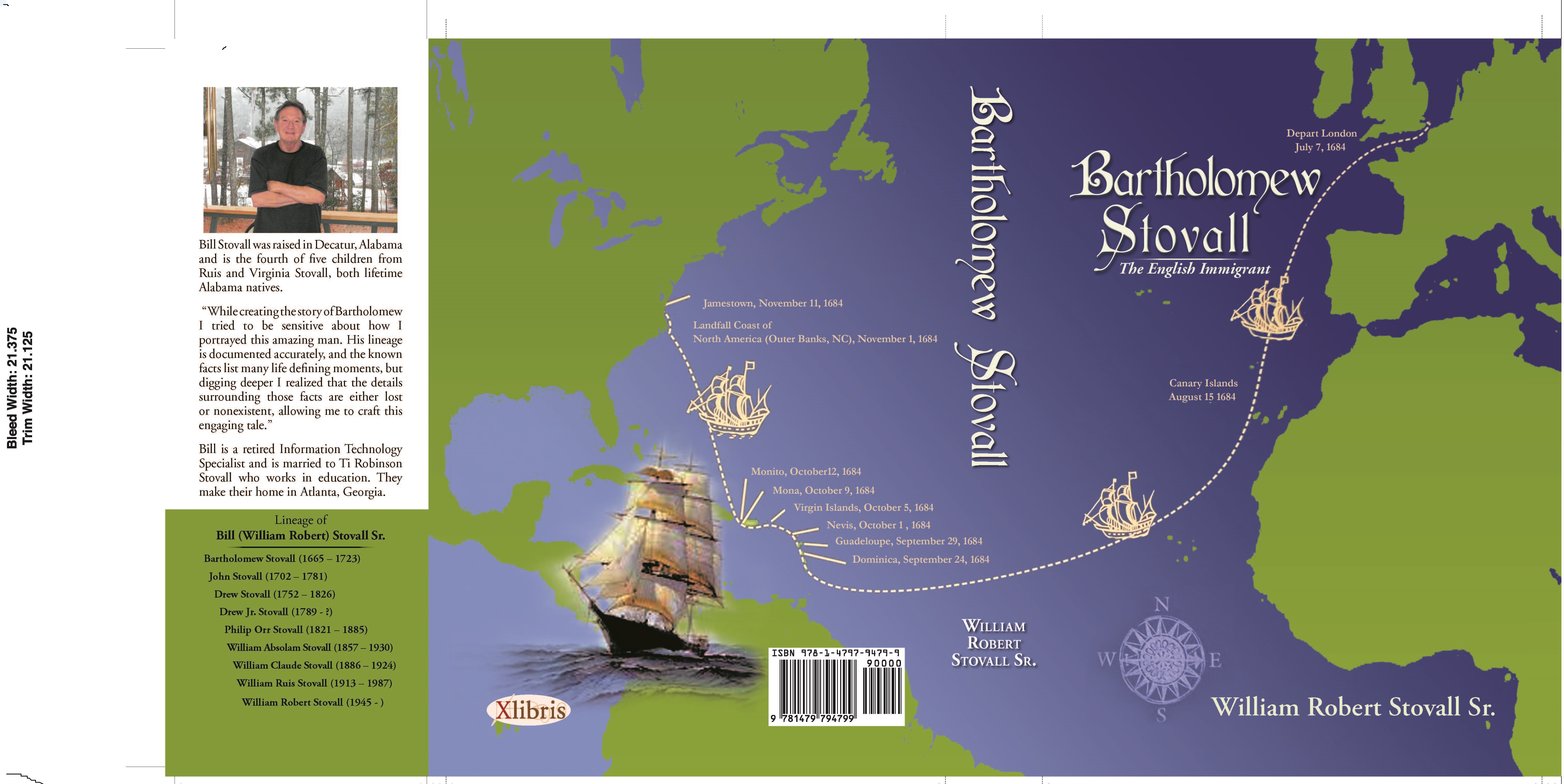
ebook Is Now Available

Cover hardback fbBartholomew Stovall – The English Immigrant is now available on ebook.  This downloadable file is in .epub and .mobi format and can be purchased for $3.99 USD from Amazon, Barnes & Noble, and Scribed, as well as the publisher, www.xlibris.com.

When you visit the bookstore for each site, search for ‘Bartholomew Stovall’.

Thank you for your patience during this formatting process and enjoy the chronicle of Bartholomew.


Posted in Uncategorized | Leave a comment

Early American Colonies – North & South

On November 11th, 1684, Bartholomew Stovall arrived in the new world, boarded a small transport vessel, and watched in awe as the craft approached the shoreline across the bay from the dying settlement of Jamestown, Virginia.  He knew his destination was the plantation of Dr. Richard Kennon, and he had knowledge that the Tidewater area was inhabited with similar operations scattered along the waterways that flowed into the James River.  Bartholomew’s thinking was correct, but it would take him years to understand the culture that was developing in the Chesapeake region of the American Colonies.

Early Chesapeake Plantation

Early Chesapeake Plantation

As the Seventeenth century was drawing to a close there were very few towns in existence south of the more populated  New England Colonies.  Plantations eventually grew into small villages but government and social order had yet to integrate into the populace of the Chesapeake.  There were a greater number of salves and indentured servants than those who owned their freedom and the ration of male to female was six to one.

The class structure consisted of plantation owners of immeasurable wealth, or the fortunate few who leased and farmed large parcels of land, followed by the poor, and then finally the slaves.

Virginia Tobacco Field

Virginia Tobacco Field

Plantations usually claimed thousands of acres containing vast fields cleared and planted with tobacco that produced harvests yielding tons of the auspicious crop bound for England.  These large farming operations owned slaves or held a contract on indentured servants.  Slaves were bound for life and could be sold or traded, the same as any merchandise, but indentures were bound for a set number of years providing they fulfill the terms of their contract.  Most indentures performed the labors of farming, but others were brought from Europe to fulfill the obligations of preparing meals, educating children, or conducting specialty-farming tasks such as blacksmithing.

The less fortunate men who owned their freedom found they had to farm seventy five acres minimum or it would be impossible to feed a small family, but alas, there was no possible way to farm seventy five acres alone.

Colonial American Farmer

Colonial American Farmer

They were a brutish lot and had but one agenda, that being the will to survive.   If a person were free and poor, there were very few places of worship and educating the young was the responsibility of family members.

All large plantations were located on a major waterway, which was used for transportation and crop movement.  Any settlement that was located away from the waterway was considered susceptible to a rogue attack by natives of the land, and if one attempted to venture too far into the wilderness their fate was dubious.

As stated earlier, when Bartholomew Stovall boarded the carrier and approached the shores of the Virginia colony, he did so of his own accord and traveled alone.  In short, the Chesapeake region was populated by individuals who, eventually, had to find their way, using their own means.

But looking north to the New England colonies there was a surprisingly different scenario taking place.  In 1620 the Pilgrims landed in Plymouth, but they were not a group of rogue young men willing to sell themselves for a period of indenture.   They traveled as families with a husband, wife and children and their cause was not to escape the hopelessness of poverty in their mother country.  They were seeking religious freedom and a desire to form a culture based on their form of a social society.  Although only half of the Pilgrims survived during the first year of settlement, they eventually laid the foundation for what was to become a model for the Puritans, who arrived ten years later with numbers in the hundreds.

The Puritans followed the lead of the first Pilgrims and traveled with nuclear families in search of religious freedom, away from the oppression and confines of the Church of England.

Colonial New England Town

Colonial New England Town

Their first order of business was to set up centers of trade in order to create a civil society as defined by their beliefs.  Churches were built along with schools and residences for those dedicated to their cause.   Places of worship were designated as governing houses, usually controlled by the religious elites or men who exhibited strong leadership qualities.

This model proved to be successful and by 1640 over 16,000 men, women, and children occupied the area around the Massachusetts Bay.  Because they traveled as families, the sex ratio was much more balanced than in the Chesapeake region to the south.  But more importantly, the survival rates increased due to a healthier climate, clean drinking water, and a heightened sense of emotional security.  In fact, the mortality rate among these early settlers compares favorably with modern day New England residents.  One historian, John Murrin, observed that New Englanders “invented” grandparents.  In other words, this may have been one of the first societies in recorded history in which a person could reasonably anticipate knowing his or her grandchildren, a demographic surprise that contributed to social stability.

Colonial Family

Colonial Family

Historians who have studied the disparity of social stability between the northern and southern colonies concede that the gap was due to the lack of traditional families.  The most likely cause can be attributed to the Chesapeake’s low mortality rate and the shortage of females.   Malaria and other diseases took a frightening toll and the drinking water was contaminated with salt, killing many in low lying areas.  One must also concede that female indentures spent most of their child bearing years in servitude.

From a historical perspective, the New England colonies were more advanced with their approach to creating a well-ordered society.  By 1650 near half of the region’s male population could read and write.  This was not accomplished in the colonies to the south for another one hundred years.  In the south, wealthy plantation owners were clearing fields and planting tobacco, totally dependent on slave labor.  In the north, towns were being built which contained schools and churches.  These were men and women with strong religious convictions working together with a common cause.

But as we enter the twenty first century it is fair to say that one region’s success does not define the entirety of a nation.  The present day mortality rate is evenly divided across the total populace, and one region’s strength may be seen as another regions weakness, depending on the matter of discussion.

But the most remarkable thing about modern day America is that regional culture is still evident from early colonial days.  The south is defined by its hospitality, which originated when seventeenth century colonial plantations always opened their doors to weary road travelers in need of a resting place.  New Englanders still hold true to their heritage and convictions, much like those who formed our first stable society.

Posted in Uncategorized | 2 Comments

Virginia Bound Mayflower Accidently Lands on Plymouth Rock

From grammar school through college Americans are taught the story of the Mayflower.  History books tell the story that in 1620, a group of English pilgrims desired to express their religious beliefs without persecution.  Believing their objectives could be achieved in the New World; they boarded the Mayflower, crossed the frigid Atlantic Ocean, and landed on Plymouth Rock.  There they established a village and during their first dreadful winter nearly starved to death before Native Americans came to their rescue.  This first act of camaraderie between the Native Americans and the pious pilgrims was the first Thanksgiving; a holiday set aside to celebrate a blessed bounty and to give thanks for the coming year.

Voyage Of The Mayflower

Voyage Of The Mayflower

The facts of this American historical drama cannot be denied.  However, few Americans are aware that an error in navigation was actually responsible for the first settlement in the New England Colonies.  As is often the case in historical events and innovations, this error proved prosperous and paved the way for America’s initial stable society that would become a model for social order in the New World.

The story draws its origin from a group in England who called themselves “Separatist” and believed that the Church of England held too many traits of the Catholic Church.  This minority group opposed the Church rituals and mandatory attendance of services.  In the early years of the reign of James I, a group from Scrooby Manor, a small community one hundred and fifty miles north of London, chose to formerly leave the state church and suffer the consequences of non-attendance rather than remain in England.  Thus, off they trekked to The Netherlands, where a more tolerant mindset regarding religious practiced was tolerated.  Indeed the Dutch were accommodating, showing little opposition to the beliefs of the newly established group.  But as the years went by and the Separatists’ children began to come of age, there arose a shared dismay that the new generation was dismissing their roots, and a plan to reestablish their religious identity began to take shape.

The plan was put into motion in 1617, when their appointed leader, William Bradford, petitioned for a land patent from the Virginia Company of London, the same group of investors who helped finance John Smith to establish a settlement in Jamestown ten years earlier.  But Bradford’s proposal was to move entire families, unlike Smith’s assemblage of young, able bodied men.  Apparently the investors saw some merit in their plan, so in 1620 they boarded a ship named the Speedwell from Delfshaven in the Netherlands and sailed out for an encounter with the Mayflower, captained by Shipmaster Christopher Jones.

The Mayflower and Speedwell Rendezvous

The Mayflower and Speedwell Rendezvous

After their rendezvous, the two ships adjusted cargo and passengers and together embarked on the frigid voyage across the North Atlantic.  But as fate would have it, the Speedwell sprang a leak and was forced to return to England.  It was later written by Bradford that the leak was created intentionally because both crew and captain feared starving to death before they could solidify a settlement.


Mayflower - North Atlantic Pasage
Mayflower – North Atlantic Pasage

When the Mayflower set sail on its lonely voyage it was packed with as much rations and supplies as possible and included over one hundred and fifty total headcount.  Its destination was fixed at between 38 and 41 degrees latitude; the area known then as Northern Virginia.  Somewhere along the way the Mayflower veered slightly north and continued that route until land was finally spotted.

Desperate to leave the ship, the company moved around the area and discovered little more than an abandoned Indian village.  To their dismay, they also discovered that they were well north of the intended Hudson Bay area, and had instead landed in New England.  Realizing that they had no charter to settle this land, they boarded the ship and tried to navigate south to their intended target, but treacherous seas forced them back to Cape Cod.  Since all in the company, including the sailors, knew they were on illegal land, near munity had to be quelled and on November 11, 1620  a group of 41 men convened and drafted the Mayflower Compact, which stated the intention to “Covenant and combine ourselves into a single body politick.”

Mayflower Compact

Mayflower Compact

This auspicious covenant did indeed parlay into a success story for the fragmented Mayflower survivors.  Thiers was a triumphant story unlike any other in the treacherous endeavors to colonize the new world.  While the Pilgrims numbered only a few dozen, they laid the foundation for the Puritans who made the journey only ten years later with numbers in the hundreds.

Although the Chesapeake colonies boast of being the initial gateway to the new World, theirs was a region that went the way of plantations and slave dependent labor.  The Pilgrims, on the other hand, laid the foundation for organized towns and cities with well-developed streets and schools that provided learning opportunities to benefit the next generations.

But would America’s story be the same had the Pilgrims reached their intended destination of Northern Virginia?  Of course we will never know the answer to this question.  We are left to speculate that it was God’s plan for the winds to push their sails in a different direction, or the mishaps of man to miscalculate the degrees of latitude.

Only half of those who landed on Plymouth Rock survived, but those few laid the foundation for the initial populous regions.  These areas spawned the learned and prosperous men and women that largely created the charters and declared America an independent nation.

Posted in Uncategorized | Leave a comment

John Smith Claims Jamestown

Captain John Claims Jamestown

Captain John Claims Jamestown

The following exchange is from Bartholomew Stovall – The English Immigrant and occured between Bartholomew and Captain Peter Pagan a short time after they made landfall in America. As they skirted the coast looking for the buoys marking the entrance to Jamestown Harbor the intoxicated Captain Pagan was attempting to explain the concept of the New World from a historical perspective while they both drank from a bottle of Rum.

Since Pagan broached the subject, Bartholomew carefully replied, “I fear the Indians, sir.”
“Damn it, Stovall, I done told you to leave them alone, and you got no worries.”
Bartholomew turned his head away, regretting the comment, and then said, “It seems as if they owned this land first.”
Captain Pagan shook his head and smiled, “Wrong Again, Stovall. Indians don’t believe anyone owns the land. They think it’s just wide open spaces with no lines to prove ownership.”
Bartholomew spoke, sounding confused, “But they fight amongst themselves for their territory?”
“Well, just think about that Stovall. Say a bunch of families make a home alongside a creek and start living on the dear that grazes close by. Then along comes another bunch and starts killing off the dear. I don’t know about you, but I think I’d start shooting back.”
Bartholomew considered the response, “Then you’re telling me their actually friendly?”
Pagan laughed to himself and then took another drink from the bottle. He handed it to Bartholomew, who knew better than to refuse.
“That’s another story altogether,” the captain said.
Bartholomew listened intently, soaking up the knowledge bestowed by Captain Pagan.
“Sometime before 1610, Captain John Smith left England with three ships and sailed along this coast just like you and me are doing right now. They finally spotted a harbor that looked friendly and named it after King James I. They called it Jamestown. So Smith found this most perfect place, got off his ship, and drove the Union Jack into the ground.
”There was a bunch of Indians out hunting, and they said, ‘Bullshit’. Little did Captain Smith know, but he had set up camp a half a day’s walk from the Indian capital of the world. There were more than 12,000 of them in one single village where their chief lived.
“So rumor has it that the chief paid them a visit and told them how things were handled in this part of the world. Smith was kind of pissed but did the numbers and decided to lay low for a while. They would have starved to death, but Chief Powhatan decided to use them to his advantage. He fed them and allowed a few more to settle, thinking he could let them have the harbor area and trade it for trinkets and tools. He was dead wrong. More and more came till there were too many. The Indians kept moving further west, and now it’s all history.”

Posted in Uncategorized | Leave a comment

Bartholomew Stovall – The English Immigrant is available!

Bartholomew Stovall – The English Immigrant is now available!

Plase your cursor over the “Order The Book” tab, select Paperback, Hardback, or
E-Book, and then follow the simple payment instructions.

Posted in Uncategorized | Leave a comment

Book Release Information

First I want to thank all of my friends for your interest for Bartholomew Stovall – The English Immigrant.  The manuscript is in a final edit and should be printed sometimes in May.  It will be available in hard and soft copy as well as e-book format.

This book is a very detailed account of his life, and begins with an interesting encounter by Bartholomew’s great grandfather, George Stovold in 1585.  I’ve written a fair amount about Bartholomew’s parents, George and Joan Stovall; attempting to paint a picture of life as a young couple who, for years, awaited the blessings of a child.  But until Bartholomew arrives in August of 1665, they struggle with their traditional religious beliefs, finally finding themselves impoverished due to exorbitant taxes and mandated tithes.

But the story of Bartholomew Stovall cannot be told in a short summary.  I spent a great deal of time with accounts from Bartholomew’s youth, detailing the difficult time England’s lower class encountered during the mid to late seventeenth century.  It is set in many locations, each of which is a story within itself.

The chronology begins in Albury, Surrey County, England with a child growing into a young man.  Then it moves to London where Bartholomew awaits the dreaded Passage, all the while encountering lifelong friendships.

The passage is detailed to a point that one rides the waves in a transatlantic voyage to freedom, only to become a slave in the new world as an indentured servant.  Finally this brave, English lad leaves the ranks of slave and moves to free and poor.  But realizing that his dreams are being achieved, he follows his quest until the story turns to one of love rather than sacrifice.

Ultimately, I would like for our blog to become a repository for all of you who wish to share information about Bartholomew, or would seek lineage information if you are a descendent.  All comments will be shared when I’m notified that they are available for viewing.  I check for submissions multiple times a day.

Thanks again for your interest in this publication.  I hope to see your blog entry soon.  Bill Stovall . . .

Posted in Uncategorized | 3 Comments

Excert from Bartholomew Stovall – The English Immigrant

This quick exchange occured between Bartholomew and a field hand named Chess just one day after he arrived at Kennon’s plantation to begin a four year indenture.

The Farming of Tobacco — Henrico County, Virginia—1685

Having consulted with Elizabeth Kennon for some time during the early morning hours, Bartholomew was late reaching the quadrant of land destined for clearing. It had been named section 9, which left Bartholomew to wonder how many sections existed.

“Can ye ride a horse?” the short, fast-moving older man asked him before hitching a wagon.

Bartholomew had to admit that he had never been on the back of a horse but was willing to give it a try. But today he would not learn to ride a horse. He was carted from the stables to section 9 in a wagon pulled by two mules. A few minutes after leaving the stables, Bartholomew realized he and his riding companion had not exchanged names.

“My name is Bartholomew Stovall,” he said, extending his hand. The man looked at him and nodded, but never offered a word as the wagon made its way down the rut-filled roadway.

Noticing several wagon trails that branched off the main trail, Bartholomew considered that it was cut to use for farming. Then they turned off the road and entered a grassy area toward a knoll. At the top, he was stunned by the site. Hills, two or three feet high, covered the acreage as far as an eye could see. Each had been strategically formed and stood a distance of no more than four feet apart.

Following the cutoff, the man turned to Bartholomew and said, as if offering a late confession, “Well, my name’s Chess.”

Turning with a nod, Bartholomew said without thinking, “Chess? Is that C-H-E-S? I’ve not heard that name.”

Chess looked away as if he was confused then finally admitted, “I don’t know letters. Say ’em again.”

“C-H-E-S. It’s a good name.”

“Can you teach me to write it?” he asked without embarrassment.

Bartholomew looked in the back of the wagon and saw a metal shovel. He placed it in his lap and put his finger to his mouth.  “This is C,” he said, forming the letter on the dust-covered surface.  After finishing the spelling, he held it up for display. “C-H-E-S,” Bartholomew said so the man could understand.

“Naw, that ain’t right.”

Both studied the spelling until Chess said, “It’s got another one,” pointing at the S.

“You make it,” Bartholomew urged, handing him the shovel.

Chess reluctantly took it and put his finger to his mouth. Staring at it for a long time, he finally asked, “Where do I start?”

After Bartholomew pointed the way, Chess wet his finger a second time and slowly made the same pattern, only larger. When he was finished, he held it up, displaying the most perfect S one could possibly imagine. It was much clearer than the other letters because Chess had put his finger to his mouth at least four times during the writing.

“That’s about a fine an S as I have ever seen,” Bartholomew told him.

Staring at the shovel, Chess asked, “Can you read?”

Bartholomew stared at him and said in frustration, “C-H-E-S-S. Chess.  That’s reading, man. Read it on the shovel. It says Chess.”

The man stared at the letters, pondering the meaning, moving his head from side to side as if to get a better view, then said, “Well, I’ll be damn,” and then he threw the tool to the back of the wagon.

                                                                   …

Traveling on, Bartholomew finally asked, “How far does this go?”

“Top of that hill.” Chess pointed to a distant knoll.

“No, Chess, how large is that?” he asked, looking back at the endless lines of neatly formed hills.

“Three hundred acres. That’s section 4. It needs to be turned.”

Bartholomew’s jaw dropped. He looked at Chess and asked, “How many sections are there?”

“Right now, six. This one’s goin’ fallow when we turn it. That’s why you’re here. They need more land cleared so they can grow more tobacco.  I hate the shit.”

After they topped the knoll, Bartholomew saw the task. Just in front of them was a line of trees that spanned from his right to left for as far as he could see. He tried to imagine so much wealth and finally asked Chess, “How much land do these people own?”

“All of it,” Chess returned, smiling back at Bartholomew

Posted in Uncategorized | Leave a comment

The Passage

Sixteenth Century Cargo Vessel
In the late 1500’s Queen Elizabeth was faced with a delima. England was in the midst of an economic depression causing thousands of downtrodden folks to flood the streets of London begging for food scraps and shelter.   This brought about public floggings or, sometimes imprisonment in workhouses, but it soon became apparent that England was best served to rid themselves of this surplus population.

At the same time the new world of America was desperate for laborers.  It seemed a simple solution to exile those unfortunates, so England emptied the jails and cleared the streets, offering those free passage to the new world where they could seek a fresh start after a period of indenture.  Thousands took advantage of the opportunity, but the reality of their consent was quickly realized soon after they boarded ships and began their passage across the Atlantic Ocean.

Captain and crew, with a full cargo of bond servants left the Port of London in midsized sailing vessels and navigated down the Thames River, finally breaking into full sail into the Great North Sea.  By the time they headed south into the English Channel, most all headrights fully understood that their opportunity was a tragic mistake.  Soon after realizing their guarantee of food, clothing and bedding were false promises many begin to protest, demanding a return to their homeland.  A selected few were quickly made examples of with beatings and isolation, only providing the minimum of rations for them to survive.

For a single passage the number of headrights ranged from fifty to sixty souls.  They took occupancy in the ‘tween decks’, a common area, where everyone was left to find sleep on the floor.  They were provided a daily ration of bread and water with meat every third day.  Waste pots were placed in the aft or stern and offered no privacy for hygiene or personal necessities.   During rough days at sea the pots spilled over into the common area leaving an odor so foul it was barely tolerable.

Following the trade winds discovered by Christopher Columbus the passage traversed past France, Portugal, and Africa before they made the first stop for food and supplies in Santa Cruz De Tenerife in the Canary Islands.  The merchants on this remote outpost were well seasoned in trade, bartering with rum and food stocks which would prepare for the long and most desolate span of the trip to the New World.

With favorable winds, they would reach Dominica, the first island in the Caribbean chain, having been at sea for six to eight weeks.  Maneuvering through the island chain was tricky as they passed Gaudeloupe, Nevis, Virgin Islands and Mona until they stopped in Monito for their last restocking before making a sprint for the North American coast.  Most spotted land off the North Carolina Outer Banks where they skirted the coastline until markers were spotted identifying Jamestown Bay. The passage could take as long as four months and left the submissive crew of headrights in a lifeless state.

During the horrifying ordeal their bread could get moldy and their water stale, but any good captain would make every effort to keep headrights alive.  Mutiny was not unheard of but those were usually thrown to the cargo hold away from the general population.  If a headright died his corpse was wrapped in canvas so it could be displayed at the destination, allowing the captain to receive his movement fee.  If that headright was under contract a plantation owner would still receive his fifty acre allotment he was guaranteed for each person he brought to the American colony.

Life as an indentured servant was indeed a brutal ordeal for those who choose to sacrifice a few years of their life for opportunity, but the passage to the New World was, by far, the most difficult span in the long road to freedom.


Posted in Uncategorized | 1 Comment

Bartholomew’s Birth and Childhood

On an oppressively hot day in August, 1665 Bartholomew Stovall was born to parents who had prayed for the blessing since their marriage eight years earlier.  Without the aid of a midwife, an anxious father was urged on by his wife until the infant made his way into a world which historians will agree may have been the worse of times.

While still an infant Bartholomew’s father, George, fell victim to the Black Plague making it all but impossible for his mother, Joan, to rise from the ranks of peasantry.  Tragedy followed mother and child until they found some sibilance of stability, providing care for the wife of a dastardly man named Richard Farley.  But as fate would have it, Bartholomew was an orphan before his eleventh birthday.

 With a strong will to survive, close friendships, and a unique ‘gift’ he inherited from his father, Bartholomew followed that path until he realized his options were too limited to risk continuing the life he had come to know. 

By the age of eighteen he made the decision to leave his mother country and find a new life in the American Colonies

Posted in Uncategorized | 2 Comments

Before Bartholomew’s Birth

In 1585 George Stovold sat unnoticed on a hillside at the outskirts of Albury, Surry Parish and watched a group of Royal Solders murder a lone cargo hauler, mistakenly taking him for a heretic Bible transporter. During the commotion a lone crate tumbled from his wagon and fell down a ravine, unnoticed by the group. After their departure he moved his horse down the hill and pilfered through the crate, finally removing a large leather bound book before hiding the crate under a pile of rocks.

Later he and his wife recognized the words written in the book to be an outlawed English version of the Holy Bible. For the remainder of their life they studied the text and made personal recording on the pages which would serve as a guide to his lineage for future generations.

By the time it reached Bartholomew’s father’s hands it was filled with words of knowledge, hope, and inspiration. The treasured ‘Stovall Bible’ would eventually become the guide Bartholomew used to direct him to his destiny away from the depressed conditions of England to the new world of young America.

George Stovall and his wife Joan, Bartholomew’s parents, continued the personal recording, and used its message as a justification to move away from the Church of England’s views, to the Quaker ways. The Tyndale Bible serves as one of the central themes in ‘Bartholomew Stovall– The  English Immigrant’.

Posted in Uncategorized | 5 Comments