Bartholomew For Christmas

Bartholomew Full Cover

A special thanks to Carol Cook Wylie of Jacksonville, FL.   Carol ordered Bartholomew Stovall – The English Immigrant earlier in 2014 and enjoyed it so much that she recently placed an order for six more copies as Christmas gifts for family members.  Those family members and their relationship to Bartholomew are:

Steve Cook                                     6th Great Grandfather
Lori Fox                                         7th Great Grandfather
John Wylie                                     7th Great Grandfather
Chrissy Mau                                  7th Great Grandfather
Shawn Cook                                   7th Great Grandfather
Terry Cook                                    7th Great Grandfather

Chrissy Mau is now living in Australia, ensuring that Bartholomew is an international success.

Thank you again Carol, and I hope your family enjoys Bartholomew as much as you.

Posted in Uncategorized | 6 Comments

Stranger In A Strange Land

July 7, 1684

Bartholomew Stovall’s fate was sealed when he signed a document granting him free passage to America in return for four years of servitude in the Virginia Colonies.  The eighteen year old English lad was to serve as a laborer/slave, but he knew well ahead this was to be the case.  Still, he was willing to forfeit these years to avoid the poverty and/or death he knew was a certainty if he stayed in England.

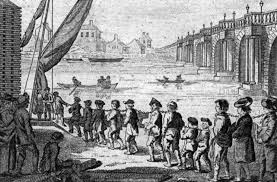
Convicts Being Led To Ships

Convicts Being Led To Ships

As he stood on the banks of the Thames he watched as  his agent, John Bright, Ship’s Captain Master Peter Pagan, and two witnesses include their signatures which made the document binding.  Surely Bartholomew must have been apprehensive to risk such a fate, but the decision was made and the deal was done.  He boarded the small longboat bound for the Booth and watched the shore line disappear into the early morning fog, knowing he would never again set foot on English soil.

In a previous blog, “‘Indenture Servants – The Reality” I recorded the reasons  a person would leave their Mother Country and start a life across the ocean in the savage wilderness of the American Colonies.
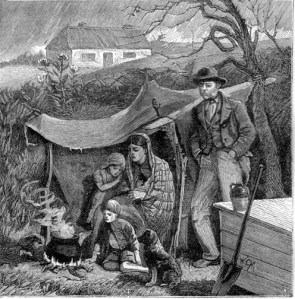
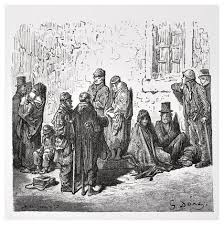
Homeless English Family

Homeless English Family

Thousands of destitute shared England’s city streets with no possibilities of rising from poverty, and starvation was a certainty in the rural areas, where handouts were nonexistent.

Some willfully tried incarceration, but petty criminals were being removed from institutions and forcibly put on ships bound for the colonies.  No one was exempt from the purge of the downtrodden King Charles had labeled as ‘surplus’.   Even abandoned children were being carted off to rid London’s streets of the ‘undesirable’.

Bartholomew’s is but one story of the thousands who were indentured servants in the seventeenth and eighteenth century.  These slaves were deposited in sites from upper New England to the Deep South.   Their plights are well documented, but let us concentrate on the tall young English lad who landed in Jamestown, VA on November 11, 1684.

American Colonies – November 1684

When the Booth finally reached America it was the beginning of winter and the weather was probably much like that in England.  I feel sure there was a chill in the air with musty conditions which left most to feel like they were not far from the environment they left.  They were probably anchored as close to the shore as possible, so the ship did not rock about as it had for four months at sea.  While they sat anchored in Jamestown everyone had the opportunity to peek out of port windows surveying the edge of the continent.  Most assuredly the first thing they noticed was the trees.  Giant pines were packed close together in a display of greenery they were not accustomed, but each man, woman and child feared what may be waiting and watching, hidden behind the wooden giants.

If you read the novel, BartholoSept25 Blog IS come to Americamew Stovall – The English Immigrant, it tells that Bartholomew was among a group of thirty or so men and women who were requisitioned by Dr. Richard Kennon from Conjures Neck, Va.  That was historic fiction, but in reality, there is nothing in the manifest Bartholomew signed which designates him to a specific location.  That being said, he probably stood side by side with other headrights and was inspected by plantation owners.  These wealthy Tidewater farmers would barter with the ship’s captain until they agreed on a price, usually £30 for a well framed healthy young man.

At any rate, Bartholomew Stovall was chosen to serve Dr. Richard and Elizabeth Kennon, on a sprawling plantation which bordered the Appomattox River approximately sixty miles from Jamestown.

Most likely Richard Kennon’s requisitions left the Booth by longboat and made their way to the western shore of Jamestown Bay.  I’m sure Bartholomew let his fingers drop into the water and sampled its brackish taste; wondering how a settlement as large as Jamestown could survive without a fresh water supply.

When the boats pulled to waters end, he stepped to the sandy shore and soon spotted giant boulders that littered the area.  Little did Bartholomew know that he would become an expert at removing these massive stones from the earth while he cleared and leveled tobacco fields.

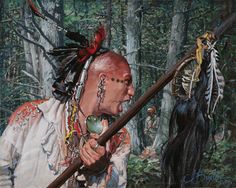
Lurking Behind Every Tree          The Great Mith

Lurking Behind Every Tree
The Great Myth

The trip from Jamestown Bay to the Kennon Plantation must have been a harrowing experience for the entire group of English slaves.  They had heard the stories of savage Indian who would attack them and remove their scalps before they were killed.  Fresh on their minds were tales of snakes larger than a man’s leg, and evil masters and field bosses that would lash you with barbed roping for the slightest indiscretion.  They were huddled into wagons or forced to march through poorly marked trails from dusk until dawn.

But much to their surprise, not one person suffered ill fate during the trek to their destination.  It was a three day trip, but rations were plentiful; much better than they had been given during the passage.  Women and children rode in wagons and men shared turns riding, while those who walked were ‘encouraged’ instead of flogged for slowing the pace.  Those servants with a fair amount of intelligence soon realized that they were a commodity and would be treated fairly, so long as they respected the rules.

The Indentures Life – Better Than Expected

After a few weeks, all indentures forgot about the savage Indians lurking behind trees.  Word spread quickly that the enemy they feared had been driven deep into the wilderness.  The fright of a moccasin, or any snake for that matter, was soon dismissed due to the frequency of sightings.  Sons and daughters lost memory of mothers and fathers.  Their focus became a will to survive the indenture contract they had chosen of their own accord.

It was not a perilous life the indenture lived.  Depending on the plantation, there was privacy, to a certain degree.  Social groups and clans developed within the masses and there were celebrations and religious festivities if they chose to participate.  Most plantation owners encouraged a controlled socialization as long as production quotas were met and everyone remained obedient.

But alas, there were those few who became bored, insulted or insubordinate.  Those who lacked control were singled out and made examples of by way of public floggings and isolation in cages on full display for all to observe.

   Swamp Runners Not A Wise Decision

Swamp Runners
Not A Wise Decision

Some chose to run, seeking their freedom, much like when they left their homeland.  Most often theirs was a terrible plight.  In addition to the corporal punishment, one month was added to their contract for each day they went missing.  Most would seek refuge in the swamps, which meant certain death due to the hostile environment.  More experienced indentures realized that there was simply nowhere to run.  Artist would draw up a likeness of runaway and post it in strategic spots around the area.  Once they were caught they were expected to pay for the advertising cost and the reward offered via additional time served.

But the same held true for both male and female servants.  If an unmarried female became pregnant her child belonged to the plantation and five years was added to her contract.  If she could identify the father, and he was an indenture, he received the same allotment of five years added.

The range of an indentures contract was from four to seven years.    The slightest indiscretion resulted in additional time served.  It was rare that a slave was released on the final date of his original contract.

It is ironic that in some cases an indenture would choose to stay on with the plantation instead of being set free once their obligations were met.  In those cases the servant was free to leave whenever they desired, and would receive food and lodging as long as they performed their duties.

But an intelligent man like Bartholomew Stovall soon realized that the obedient servant received more gratuities when they completed their contract.  It is not known when Bartholomew was released from his obligation, but soon after he was scheduled to be free, land grants were found that listed his name, all being in and around Henrico County.

No documents have been uncovered that details Bartholomew’s period of servitude to Richard Kennon.  In addition, no records have been uncovered that specify what compensation Bartholomew received after his contract ended.  As stated earlier, there was evidence that he was involved with multiple land transactions as well as minor legal matters that were all resolved.

The most significant facts about Bartholomew is that he raised a large family, lived a prosperous life, and amassed a large farm on a major waterway which was bought and paid for by the time he passed in 1723.

Given all the known facts about him, I would conclude that despite the adversity Bartholomew had to overcome, literally from his birth, he was probably a man of superior intelligence who applied himself with a single focus to achieve.

It is said that one in ten indentures survived and one in one hundred accomplished as much as Bartholomew Stovall.  He was, indeed, an exception to the rule.

Posted in Uncategorized | Leave a comment

Bartholomew Stovall After One Year

Greetings To Friends of Bartholomew!

Bartholomew Full CoverPlease allow me to catch you up on the details of our living blog, give you some insight on the status of Bartholomew Stovall – The English Immigrant, and finally I will solicit your help, asking how we can proceed with a number of topics in order for our living blog to continue.


Bartholomew Stovall The Novel – One Year After Release

The beginning of 2014 saw a flurry of activity generated by the release of my novel, Bartholomew Stovall – The English Immigrant.  Most everyone advised me that if I maintained a reasonable level of news and information releases it would take six months for the book to gain exposure.  Since I released in May of 2013, I can now advise that their estimate was spot on.

The interest it has generated from Stovall’s all across America and throughout the world has been overwhelming.  Sales for the novel have been modest at best, but this is not an indication of the novel’s success.  I have received inquires and heartwarming stories from all over the US and the world.  I will admit that the volume of correspondence has been overwhelming.  One gentleman told me he is on the third reading of the book.  Another gentleman informed me that his ninety three year old mother will not return the book, forcing him to order a second copy.  A Stovall from North Carolina ordered six copies for gifts at Christmas, and a young girl in Uganda placed an order.  When I advised her that, due to the cost of shipment, it may be better for her to order an ebook, she insisted that I mail and autographed copy.

For those who requested autographed copies most were via a personal letter with a check enclosed.   Almost everyone included a brief letter, thanking me for the effort and then went into detail about their lineage via Bartholomew.  Probably 20% of the requests for autographed copies were through Paypal.

Our blog has generated so much attention that I receive daily emails and phone calls from people who are interested in their Stovall lineage.  Many question the details of what I’ve written, while others confess that the novel is so convincing that they find it difficult to determine the truth from fiction.  I’ve received dozens of emails from folks wondering if I am in possession of the Stovall Family Bible.

I do answer every inquiry, but there are times where I simply don’t have resources to give inquiries the attention they deserve.  Normally I suggest they go back to the county of the individual’s birth and start with historical records.  It’s been my experience that, if an old family Bible is not available, the county archives are the most reliable source of information.

Stovall Family Database – A United Effort

Stovall DatabaseAs I stated earlier, the creation of Bartholomew Stovall – The English Immigrant afforded me the opportunity to meet descendants of Bartholomew from around the globe.  At last count there were over two million of us who claim ties to Bartholomew. Can you imagine what could be accomplished if we combined the efforts of half, or even a third of these individuals to answer the unsolved questions about our lineage?

Having said this, I feel more strongly now that there should be a  centralized Stovall Database that would be a reliable source of information for all Stovall’s regardless of their line from Bartholomew. Through the correspondence I have received I’ve found there is a tremendous surge in the popularity of the sir name Stovall, and many individuals are involved in efforts to capture lineage information to various renditions of a Stovall Database.  Several of the people I have talked with make this their hobby, while some do it full time as a concentrated effort.  Other editions of the database had to be the result of someone’s lifetime passion, as all lineages are represented.

In all cases, this is an ongoing process that is either an error filled venture or one that is so large that it may be impossible for a single individual to reach the end.  Yes, it does seem like an impossible task, but that does not offer as an excuse to abandon the effort.

Moving Forward Using a Combined Effort

Stovall Family Association Seal

Stovall Family Association Seal

Recently I was asked by the Stovall Family Association  to consider the position of Publisher for their Quarterly journal.  I accepted this request and my name will be submitted to the SFA Board for appointment at the next meeting, July, 2014.

For those who are not familiar with the Stovall Family Association I would suggest you visit www.stovall.org.  The SFA does not vigorously recruit new followers and is not a group with a member list as large as one might expect.  Although they have a relatively small member list (slightly over 200) this organization has a clear mission statement and a very strong infrastructure.

They have a board of directors, a journal that is published quarterly, a stated set of by-laws, and a detailed attempt at a complete family database.  Every three years they hold a national reunion with planned activities that normally stretch over a long weekend.

As far as I know, this is the only national Stovall family grouping organization in existence.

Just recently there has been a change in some of the SFA leadership positions.  I’ve talked with the newly appointed President and was encouraged that one of their primary goals is to increase membership.  She also requested that I submit ideas to modify the format of the journal to broaden the appeal for the anticipated new subscribers to SFA.

I willingly accept the challenge of producing and enhancing a journal and will approach this task with appreciation that I’ve been asked to guide this effort.  I also request that all the readers of this blog entry consider joining the SFA and support the effort to increase membership.  I also ask that each of you consider the list of items below to help make this venture a success..

  •  It will be impossible for me to produce a meaningful journal unless I have contributions from you.  I would appreciate any submissions that are Stovall related, but will also welcome any articles you think would be enjoyable and informative to readers of the journal.  I will gladly give you full credit for articles used in our quarterly newsletter.  You can forward submissions via email to bartholomewstovall@hotmail.com, or by sending them to my personal address to :

Bill Stovall
172 Castleair Ct
Kennesaw, Ga 30144

  •  I am keenly interested in any and all attempts to create lineage information for Bartholomew or his ancestors.  Please notify me if you are involved in an ongoing effort to define your lineage or are in possession of some form of updates such as a family Bible, old correspondence (letters etc), or anything else that has been passed to you.  This could possibly be used to fill in some gaps for a unified Stovall Data Base.  Might I add that I am aware of three specific projects currently underway to complete Bartholomew’s lineage in totality.  I welcome all these efforts and will work with the authors or agents of this information and present them to the SFA board to determine how they can be used to complete a comprehensive Stovall Data Base.  May I stress that currently there is no “Officially Sanctioned Database” for the SFA.  It would be my suggestion to take the most complete effort and adopt it with additions and updates that have been validated.
  •  As stated earlier, we need to concentrate on increasing our membership numbers in the SFA.  Everyone could help if they contacted relatives or friends and made them aware of our existence.  Visit www.stovall.org for complete information on how to join the SFA and start receiving the quarterly Stovall Journal.
  •  Please help to keep our living Blog active.  Visit WWW.BARTHOLOMEWSTOVALL.COM and click on the Blog tab.   It is my goal for this to be a two way dialogue between blog users and myself.  I will strive to include a new entry at least once a month with articles ranging from updated Stovall news, historical references to the life and times during Bartholomew’s period, updates on lineage information for the Stovall Data Base, and other relevant information.

Thank you very much for viewing this long post, and remember the next scheduled activity is the Stovall Family Association, Inc. 2014 – National Reunion in Richmond Virginia.  The dates are July 18, 19, 20.  Please view www.stovall.org for details on this event.

Regards,
Bill Stovall

Posted in Uncategorized | Leave a comment

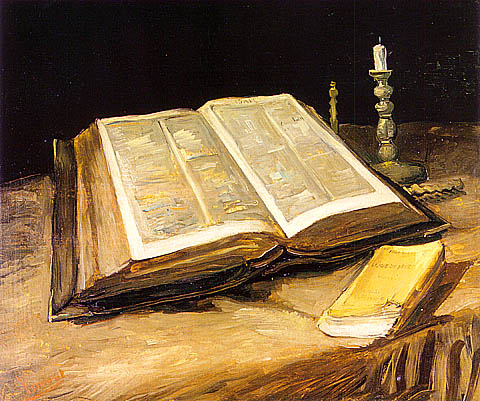
The Stovall Family Bible

The Stovall Family Bible

The most frequent question asked from readers of Bartholomew Stovall – The English Immigrant is, “What happened to the Stovall family Bible?”  It was customary for family’s to keep a legend of births, marriages and deaths, but during my research I must admit that I only found documented life events recorded in old Quaker records, legends from the Church of England, and recorded government information or bills of trade.  The cherished Stovall Family Bible was a fabrication to enhance the story.

During the initial creation of the novel I felt it was necessary to create a central theme which could be used to remind readers of the past as the chronology advanced through Bartholomew’s aging.  Most all readers of the novel feel an attachment to the hand written notations left by three generation prior to the birth of Bartholomew, but without the personal notations, the Tyndale Bible itself is a masterpiece.

Road into Albury

Road into Albury

The year was 1585 when George Stovold pulled his horse into hiding on hills away from a roadway after he heard the thundering hooves of royal guards approaching from his front, towards Albury.  He could see the glare of torches when the group of fifteen or so fully armed men stopped a lonely traveler driving a cargo wagon with a covering draped concealing the contents.

George was far away and could not make out the words, but was able to see three men dismount and undo the draping around the wagon.  Finally one man held up a book and yelled, “Dismount Atkins!”  When the driver stepped down, the horse pulling the cargo lurched and caused some of the items to fall from the wagon, one box tumbling down a ravine out of site from the calamity.  The driver showed some fright and made a movement towards his coat pocket causing the armed guard to overreact and fire a shot that hit Atkins, causing him to collapse on his back with his arms fully stretched.

After a flurry of activity the wagon was secured with the covering, including Atkins’ body, and rode off in the direction towards Albury.  While George calmed his mare two guards returned and dismounted their rides, cleared the roadway of any evidence, and then rode off in the direction they came.

Convinced that there would be not return visit from the armed assembly, George Stovold made his way from the hill and descended down the ravine in search of the mislaid chest.  In the darkness of a half-moon he fumbled through some papers until he laid his hands on a book that had a cover of fine, thick leather.  Unsure if he should take possession of it he finally tucked it under his arm and made his way back to his mare.

The Bible of George Stovold

The Bible of George Stovold

Later that evening he sit at a table with his wife, opened the book slowly, and with the aid of two candles, made his way through the initial phrase:

In the begynnyng God created heauen and erth. The erth was voyd and emptie, and darkness was vpon the deep, and the Spirete of God moued uponne the water, Then God sayde: let there be lyghte . . .

 When he finished the phrase, Lettice, his wife, said in shock, “It’s a Holy Book, George. It’s the book of God.”

And so it was that the Tyndale Bible was introduced in one of the initial stories of Bartholomew Stovall – The English Immigrant. When the Bible came into the possession of George Stovold it was used as a study guide, reference material, and a document to record examples of how everyday life related to the interpreted words from William Tyndale.

George Stovold was not as shocked as his wife when reading the opening phrase from the Tyndale rendering.  He had been briefly introduced to English translations of the Bible in his youth when he struggled with the earlier translations from John Wycliffe, who in 1335 undertook a translation of the scriptures from Latin to the English.  Little did he know that as he fought his way through the earlier translations that he was preparing himself for an understanding of the true father of the English Bible.

Sometimes after 1511 a young Tyndale came to Cambridge to study Greek and certainly to study the Scriptures more at leisure.  Earlier at Oxford he had been instilled with the ambition to give the English people a translation of the Bible based not on Latin but based on the original Greek and Hebrew.  Said Tyndale, “If God spare my life, er many years I will cuuse a boy that driveth the plow shall know more of the Scripture than the Pope doest”

Unfortunately most people of authority looked upon Tyndale’s plan for a simplified Bible as a threat to their livelihood, causing him to move from one country or city to another, literally staying one step in front of his persecutors.

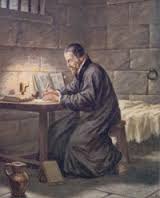
Imprisoned William Tyndale

Imprisoned William Tyndale

Tyndale’s sacrifice for his cause has long been appreciated, but it is doubtful if many today know how direct and pervasive his influence was on the English Bible.  It was Tyndale who established its tone that the Bible should not be in the language of scholars but in the spoken language of the people.  Tyndale used the word “congregation” instead of “church,” “love” instead of “charity,” “repentance” instead of “penance,” and so forth.  He coined such words as “Passover,” “scapegoat,” “mercy seat,” and “long-suffering.”Many expressions of Tyndale are also unforgettable, cherished by countless readers of the English Bible: “the kingdom of heaven is at hand” (Mtt.3:2); “the pinnacle of the temple” (Matt. 4-5); “the salt of the earth” (Matt. 5-13); “daily bread” (Matt. 6:11); “meek and lowly in heart” (Matt. 11:29) “shepherds abiding in the field” (Luke 2:8); “eat drink and be merry” (Luke 12:19); “fatted calf” (Luke 15:23) “only begotten son” (John 1:14,18), “in my father’s house are many mansions” (John 14:2) “God forbid” (Romans 3:4); “sounding brass” and “tinkling cymbal” (1Cor. 13:1); “in the twinkling of an eye” (1 Cor. 15:32);  “singing and making melody” (Eph. 5:19); “office of a bishop” (1 Tim. 3:1);  the pleasures of sin for a season” (Heb 11:25); “an advocate with the father” (1 John 2:1); and “Behold I stand at the door and knock” (Rev. 3:20).

The above is a short list of quotations from the 1534 edition of Tyndale’s New Testament, except the spelling has been translated differently from the Greek Text, yet because Tyndale had such an ear for the English language, these phrases live on.

The Burning of William Tyndale

The Burning of William Tyndale

William Tyndale never fulfilled his life’s passion of completing the English Biblical translations.  Psalms, Proverbs and the Ecclesiastes were among the paramount recordings God bestowed, but were not bought forward by Tyndale’s sanctified mind.  He was convicted and found guilty of Heresy and then strangled and burned in a field just a short walk from the castle in Vilvordre, near  Brussels.  His dying words amplified for generations as he cried, “Lord, open the King of England’s eyes.”

Tyndale’s words may have sounded as a plea from a dying man, but it opened a flood gate for those who understood the task he was unable to complete.  Miles Coverdale, a friend of Tyndale followed with a complete recording that was circulated without hindrance.  John Rodgers created the Mathew’s Bible in 1537 and was considered an improvement on previous translations.  In the same year the Great Bible, edited by Coverdale, was the first English Bible to be placed in the Churches in England.  Henry VIII encouraged it’s placement in each pew in the land.

But in 1650 the Geneva Bible became the standard, produced in legible type, in small form with commentary and illustrations.  It was the first translation to print each verse as a paragraph and to put words in italics not represented in the original text.  It was the Bible of the Jamestown settlement in Virginia and was the Bible brought to Plymouth on the Mayflower.  The Geneva Bible was labeled as the bridge between the Tyndale version and the King James Version rendered in 1611.

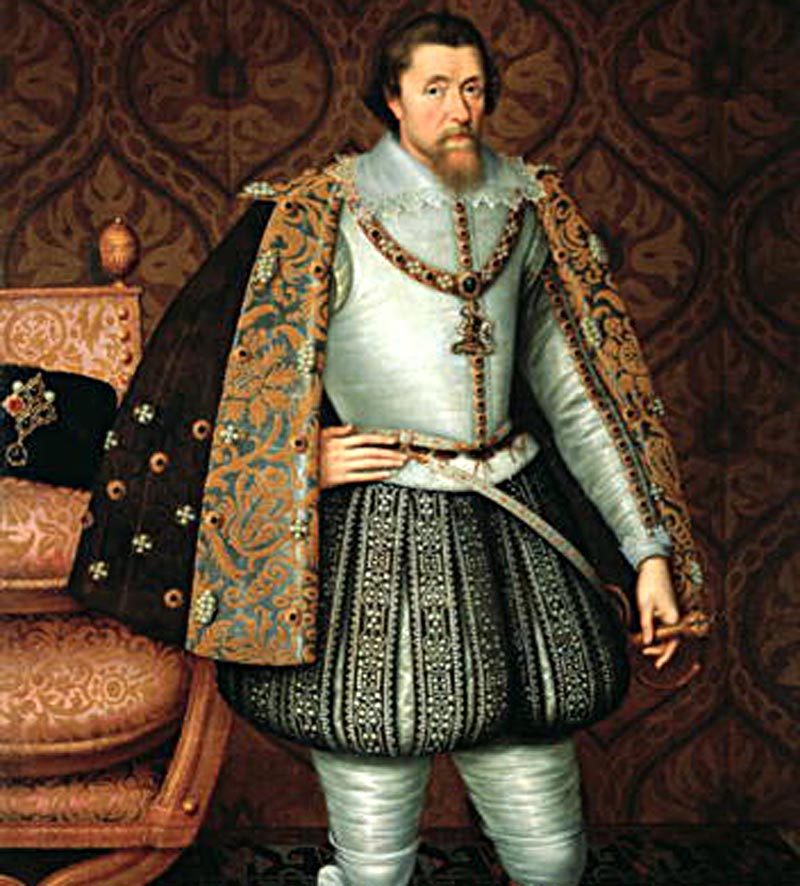
The Infamous King James I

The Infamous King James I

King James, despite all his faults, was able to do something no one, up until his tenure, was able to do.  He summoned a meeting of representatives of diverse religious groups to discuss the question of religious tolerance.  The group was known as the Hampton Court Conference and the main topic was the possibility of a new translation.  Despite his faults, King James demanded the new translations withhold the private viewpoints of any one party.  Thus, a universal Bible was formed.  One of the most astounding phrases was the quotation, “Appointed to be read in Churches.”   But the most profound statement was, “The translators to the readers.”  This statement validated all previous versions of The Holy Bible.

The Hampton Court Conference was an astonishingly successful gathering.  Despite the fact that the King James Version has gone through hundreds of editions and modifications, the core rendering still holds its significance as the standard among a unified text for Christianity.  But if an analysis of the basic translation were examined, eighty percent of Tyndale’s archaic terms and para phrase substitutes were retained by the learned men who created the version set down by the guidelines established by King James over four hundred years ago.

But as it is put by pen to fiction in Bartholomew Stovall – The English Immigrant, George Stovold purely understood that he could finally read God’s word and known the meaning as was written in comprehensible verses.

Special thanks to Neil R. Lightfoot for information on William Tyndale explained in his novel “How We Got the Bible”.

Posted in Uncategorized | Leave a comment

1666 Samuel Pepys Diary – Bartholomew at One Year

Bartholomew Stovall at One Year – Reflections With Joan

One year and two months after the death of her husband, George, Joan Stovall no longer felt the heart aches of loneliness. On this day she gave thanks for a healthy fifteen month old son who had become her life’s focus.  She also gave thanks for the family of William and Faith Gentry, who helped enable her so she wouldn’t become impoverished.

On December 31, 1666, Joan Stovall reflected and realized that she had experienced sorrow during the year past, but also understood that her life could be much worse.  All of England was suffering and she feared that, eventually the political, social, and economic conditions could prove ruinous for a person in her vulnerable position.

Joan and Bartholomew

Joan and Bartholomew

But on this evening, she closed out the year in the comfort of the rocking chair her husband had built.  As she nursed her son Bartholomew, she gave thanks for all God’s blessings, and she prayed for those who were less fortunate.

When Bartholomew’s eyes closed, Joan allowed her mind drift.  She recalled the short span God had given her and her husband; sharing the blessing of their son.   She could feel her husband’s closeness as she looked down at his image in Bartholomew’s face.  Joan Stovall prayed for courage and continued good fortune, but she would not allow herself to cry.

Samuel Pepys – December 31, 1666

Post Nov 16 Samuel PepesOn December 31, Samuel Pepys sat at his desk and made the final entry into a personal diary for the year of 1666.  Mr. Pepys, a naval administrator and Member of Parliament was one of England’s most notable personalities, but history shows his most significant contribution was his daily recordings, preserving small details of life in London for the decade beginning 1660 and ending 1669.

Pepys lowered his pen and rubbed his eyes attempting to relieve the tiredness from working with poor light.  Before filing away the journal he did a quick survey of the final paragraph and chuckled to himself, “Tis true I could have neglected my writings and concluded the year with this summation.”

Rising forward in his chair he pulled two candles closer, and read:

Our healths all well, only my eyes with overworking them are sore as candlelight comes to them, and not else; publick matters in a most sad condition; seamen discouraged for want of pay, and are become not to be governed: nor, as matters are now, can any fleete go out next year. Our enemies, French and Dutch, great, and grow more by our poverty. The Parliament backward in raising, because jealous of the spending of the money; the City less and less likely to be built again, every body settling elsewhere, and nobody encouraged to trade. A sad, vicious, negligent Court, and all sober men there fearful of the ruin of the whole kingdom this next year; from which, good God deliver us! One thing I reckon remarkable in my owne condition is, that I am come to abound in good plate, so as at all entertainments to be served wholly with silver plates, having two dozen and a half.

As England purged the most horrid year in its history, one needs to do a careful analysis on Pepys’s entry to understand its significance.

The great plague of 1665 was lessening its grip on London, but body carts could still be spotted in the streets ready to remove a corpse for cremation.  All told, the plague had claimed the lives of more than 100,000 people in a two year period.  Fragmented families shared the streets when King Charles II reasoned that residences ‘leave the city to lessen the spread’.

The Second Anglo-Dutch war ravaged through the year, but by the end of 1666 it was apparent that the Dutch would continue their domination of world trade.  England’s navy had been soundly defeated and its economy was so short of cash it was barely able to block a land invasion at the mouth of the River Thames.

By the end of 1666 English and French relations had eroded to the point that those in France wondered if the English’s demise would be by fire or the Dutch.  Fearing another French/English war was emanating, the power mongers of England questioned where the funds would be found to defend themselves.

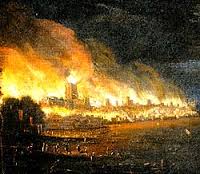
The Great Fire of London 1666

The Great Fire of London 1666

On September 2, England was shaken to its foundation when the Great Fire of London consumed over 13,000 homes, 87 parish churches, and displaced 70,000 of the city’s 80,000 residence.  Spared was the Westminster district and the King’s Palace at Whitehall, but the damage was so extensive, many thought the city would never be rebuilt.

Charles II again encouraged the homeless to move away from London, insisting that neighboring cities and townships accept those, “whatsoever shall without any contradiction receive the said distressed persons and permit them the free exercise of their manual trades”.

In short, London was crumbling.  The nation of England pleaded for guidance from a monarchy that knew little of conditions outside its closed walls.

But Samuel Pepys final entry for the year 1666 concluded with a tone of optimism.  He spoke of prosperity among the ruins and seemed amazed that his accumulation of silver plates was more a sign of good times ahead.  As selfish as it sounded, Samuel Pepys spoke of hope and prosperity.  King Charles II, who was handed the task of restoring the city to greatness after the fire, understood that hope would be instilled by evidence of optimism and prosperity and could be attained only if that attitude prevailed.

English Poor

English Poor

It’s unfortunate that the staggering populace of England couldn’t view conditions through the eyes of Joan Stovall, for if they did they would see evidence of optimism and prosperity that would lift their spirits and, indeed, allow that attitude to prevail.

It was the worst of times in England’s history, but for anyone who found themselves in Joan Stovall’s position, worst of times was ambiguous.

Posted in Uncategorized | Leave a comment

November 11, 1684 – Jamestown Virginia Colonies

November 11, 1684

The Booth

The Booth

Three hundred and thirty nine years ago today crew members aboard the salve hauling ship, Booth spotted several red buoys that marked the entrance to a large bay, and tacked to its port side pointing them in a direct line towards the dying settlement of Jamestown, Virginia Colonies.    She carried fifty four headrights, eleven seasoned crewmen, and Captain Peter Pagan, one of the finest captains to ever sail the Passage from England to North America.

Most of the headrights were destined to work four years of servitude, growing tobacco on the plantation of Dr. Richard Kennon.  The remaining headrights would be put on display and sold to the highest bidder, desperately in need for laborers or servants.

It is written in Bartholomew Stovall – The English Immigrant that the Kennon plantation was in such need of help that they purchased the contracts for all of the headrights, less a few that were not acclimated to manual labor.

When the ship anchored in the large bay, a boat with oarsman had departed the settlement in Jamestown to meet Captain Pagan and welcome him to his terminus.  They assured him that supplies would be delivered should he be short of rations, and advised him that a message had been delivered to Kennon  that all indentured servants were alive and acounted for.

At any rate, Captain Pagan had delivered another cargo of headrights and his four month journey across the Atlantic Ocean had been timed to perfection.  They had left Manito with strong north westerly winds blowing into their larboard sails and after a twenty day sprint, made landfall on November 1.  They kept sight of land and followed the coast line of the Outer Banks, North Carolina for two weeks, until they finally spotted the Jamestown settlement.

It was a bittersweet moment for Captain Peter Pagan.  His cargo was delivered, but now he must bid farewell to Bartholomew Stovall, a nineteen year old young man who had left a lasting impact on this seasoned sailor.

November 1, 1684

The short passage below was taken from Bartholomew Stovall – The English Immigrant.  It details the culmination of a four month voyage escorting fifty four headrights, crew and Captain from The Port of London to their first sighting of mainland America.

It was not in the light of day that they would arrive in America, but in the dark of night. As the cold winds pierced through the closed porthole windows, the night watchman shouted, “Land! Land! Land!”

Within seconds, the ship stopped as if a bird had dropped to the ground in midflight. Without making headway, heavy waves tossed the boat around like a child playing with a toy. Loud noises were heard on the main deck as the crew worked feverishly to secure the craft from floating about. Suddenly, the long, continuous sound of metal on metal was prevalent.

“We’re dropping the anchor,” Bartholomew said, looking at Will, then up to Mary.

New World At Day Light

New World At Day Light

After a while, Bullard made his way down the steps into the tween decks. When he reached the bottom, he took off his hat and looked at the crowd and half admitted, “Well . . . we seen land . . . I think. The lookout swears he saw a fire in the distance. We won’t know for certain until the sun rises in the east. We’re gonna rock about all night so try not to get sick. The water is cold, so swabbing the deck won’t be so refreshin’ this time.”

Having said this, Bullard made his way up the steps and closed the hatch, leaving all those below more anxious than they had been since leaving London four months prior.

“We’re here,” Bartholomew said, speaking to himself. “We’ve arrived in America.”

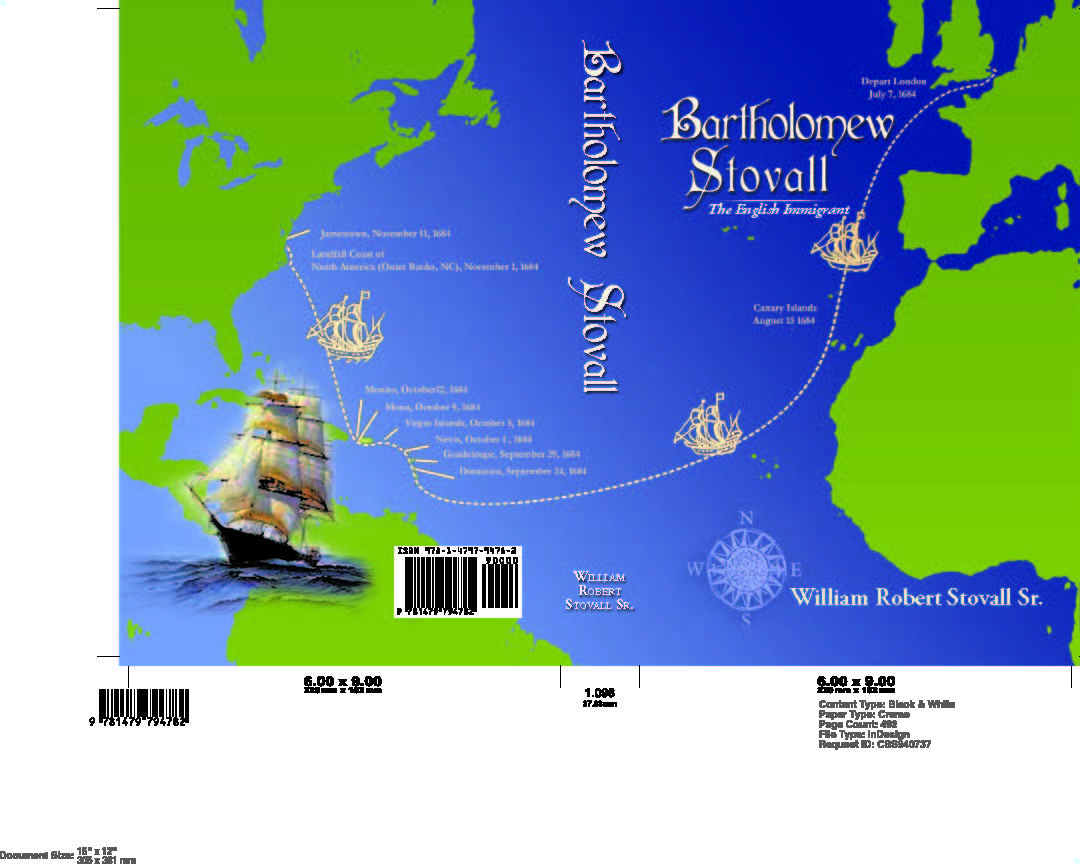
Bartholomew Stovall The Passage

Bartholomew Stovall The Passage

The ship had left The Port of London on July 7, 1684 and followed the trade winds south, first stopping at Santa Cruz De Tenerife, Canary Islands to take on supplies.  They proceeded south, southwest for the longest leg of the voyage until they arrived in the West Indies.  It was a three week jaunt that carried them past Dominica, Guadeloupe, Nevis, Virgin Islands, Mona, and finally Monito until they restocked and readied their ship for the final sprint north until they finally found the North American mainland at the Outer Banks, North Carolina.

The New World

The New World

As noted above, the crew had to wait until sunrise before they could be assured that they had reached their destination, but when the sun broke in the east all aboard the Booth were summoned to the main deck to gaze at the most breathtaking view of greenery any had ever witnessed.  The virgin land of North America lay to their west, with perfectly blue skies and a fresh breeze that made all forget, for a moment, the horrid passage they had finally completed.  For a brief moment they took leave of their reluctant state and gazed at the beauty that was the New World.  Finally they had arrived in America.

Posted in Uncategorized | 9 Comments

Whatever Happened to Bartholomew’s Farm?

So, whatever happened to Bartholomew’s farm?  It’s a question that comes up often from readers of Bartholomew Stovall – The English Immigrant.  It is a fact that he settled on 320 acres (more or less) in what is currently Powhatan County, Virginia at a point where Deep Creek empties into the James River.  He relocated there approximately 1706, raised a family of five sons and one daughter, and then passed away in 1723.

His will specifically states that his sons retained portions of the property, but that his executioner, named Ann Stovall, divide the land as sees fit.  Ironically, Bartholomew had documents drawn up that granted 100 or so acres to Hagar Taber and that the tract remained with her two sons for as long as they live.

When I created this novel, I stated in the epilogue that I would not attempt to provide information on Bartholomew’s lineage for fear that I may give misleading or false information because of the varied results encountered during my research.  As a result, I did not document what happened to the 320 acres during the lifetime of Bartholomew’s children.

New Ownership,   New Direction

Philip St George Cocke

Philip St George Cocke

In 1838 approximately 1,200 acres of property then known as Belmead, was purchased by Philip St George Cocke, Bartholomew’s 320 being a part of the closure.  Mr. Cocke was a native Virginian and a West Point graduate with an ego as large as his pocket book.  He used slave labor to construct a grand plantation filled with stately buildings and vast fields of tobacco, corn and wheat.  Some slaves he dispatched to England to learn the art of utilizing the land’s natural resources, eventually producing building materials of timber, stone and clay, further enhancing  the farming operations.   His reputation as a farmer reached its pentacle during the midpoint of the nineteenth century when he became president of the Virginia State Agricultural Society.

But in 1861, during the initial stages of the American Civil War Philip St George Cocke was appointed Brigadier General by Virginia Governor John Letcher and assigned to command all state forces along the Potomac River.   Under the supervision of General Robert E Lee, Cocke performed admirably, but when the Virginia army consolidated with the provisional army of the Confederate States, he was demoted to the rank of Colonel.   It took him eight months to retain the rank of Brigadier General, but the horrors of war and the perceived unfavorable sights from his commander General John Beauregard left him a defeated man. He returned to his mansion at Belmead in December, 1861 and took his own life from a self-inflicted gunshot wound to the head.

The Drexel Family

Farming operations continued by the sons of General Cocke until 1890 when members of the Drexel family of Philadelphia purchased Belmead.  Katherine Drexel, her sister and her sister’s husband had a vision for the land on the James River at Deep Creek far different from that of slave labor and environmental exploitation.  Katherine’s uncle had founded Drexel University and she was in the process of establishing missions across the United States with the intent to help Native American men and women.

In 1887 she met with Pope Leo XII and asked that missionary priests be sent to help with the cause.  Pope Leo was sympathetic to her plea, but set forth a challenge by suggesting, “Why not, my child, yourself become a missionary?”

St Katharine Drexel

St Katharine Drexel

Confronted by her religious leader, Katherine Drexel was stunned by his response, but through prayer and a renewed challenge she set about the task by creating a foundation that focused on providing help for underprivileged African American and Native American men and women.

If one were to study the contributions from the Drexel family it would be unfair to summarize in this small post.  It was an affluent family that encouraged that their wealth be shared with the less fortunate.  Through Katherine Drexel’s ministries and the creation of the Sisters of the Blessed Sacrament, tens of thousands of underprivileged young men and women left its boarding homes and military school with a renewed sense of self-worth, encouraged to make the world a better place.

St Francis de Sales and St. Emma

St Francis de Sales and St. Emma

The 2,200 acres on the James River was filled with grand buildings, dormitories, and study halls, all built and maintained to provide a refuge of opportunity for the underprivileged.  Operating under the name of St. Francis de Sales at Mt. Pleasant and St. Emma at Belmead the mission of this Holy place remained intact.  With little outside help the facility was self-sufficient, to the point that it generated its own electrical power.

The Closing of St Francis de Sales and St. Emma                                                               

But in the early 1970s a series of events lead to the closing of Belmead.  Public schools across the United States were experiencing forced integration, boarding schools begin to loose their appeal, and financial support declined to the point that buildings had to be demolished because there was not enough revenue to pay the tax assessments.

Forty years after the closure, most of the building have decayed with activities dwindling to a nature preserve, a leisure riding stable, and an occasional planned social event.

Today at FrancisEmma Inc.

James River at Belmead

James River at Belmead

Today the property is known as FrancisEmma Inc.  Deep Creek still meanders through the marsh and empties into the James River near the boundary of the 2,200 acre sanctuary.  A lowlands area embraces the James along the entire border, intended to preserve a habitat for species natural to the area.

Only four members of the Sisters of the Blessed Sacrament remain, along with a group of loyal supporters and volunteers.  They are currently devising a massive project to raise $7 Million dollar to reestablish the property as a scenic attraction.  Initially, $2 million is dedicated to replacing the leaky slate roof and make other repairs to the manor house.

By in large the property is over grown with tall grass and marshy lowlands.  Sister Maureen Carrol, executive director of Francis Emma explains that, “It’s prime real estate, but we don’t define it as prime real estate.  We define it as holy ground.”

They are enacting a plan to reuse both sites in a manner consistent with the values of the Sisters of the Blessed Sacrament. The primary goals are to establish outreach ministries and provide needed services to the surrounding community.  When work is completed on the Manor house, the sisters hope to capitalize on its distinctive beauty by hosting weddings and other events. In addition, the sisters would like to transform the old St. Francis building into a STEM school for disadvantaged youth, focusing on science, technology, engineering and mathematics, as well as possibly the arts. They also want to restore the land itself as a natural preserve, making it a destination for scientists, naturalists and even stargazers; already 1,000 acres have been placed in a conservation easement so it will not be developed.

Lowlands at Belmead

Lowlands at Belmead

Touring the land you get a distinctive feeling that all efforts are being made to retain the natural beauty of this historic parcel, but the most vivid feeling comes when you travel by boat down the James River and round the bend that approaches FrancisEmma.  It’s then that you realize the efforts that have been made to ensure that the natural beauty that has existed for centuries is evident as we enter the modern era.  It truly is like taking a step back in time, probably much like when Bartholomew Stovall walked through this virgin forest and gazed at the giant trees and vast fields spotted with low marsh lands.

So, if the question ever arises, “What ever happened to Bartholomew’s farm?”  The answer lies in a direct quote from Sister Maureen Carroll, “We’re planning that this place will certainly outlast us … until the ‘seventh generation,’ ” said Carroll, “which is the Native American way of saying forever.”

Allow me to quote directly from the web site http://www.francisemma.org

Remembering the Story of a Sacred Place
Francis Emma believes that
Land is much more than a parcel of real estate to be used, bought, or   sold.
Land is part of the living organism called Earth, on loan to us from the Creator.
Land is one of the primary revelations of the love, mercy, wisdom, and   beauty of our Creator.In an era in which the natural world is being relentlessly destroyed, a unique track of land on the James River is entrusted to the entire Earth community. The natural beauty of this land, manifested in its forests and wildlife, its streams and wetlands, compels us to advocate and care for the land by preserving in perpetuity its primordial wonders.Therefore, we honor the rights of the land and the fiduciary responsibility we have to the Sisters of the Blessed Sacrament and their mission.

The mission of St. Francis/ St. Emma
is to maintain a place where the interrelatedness
of all living being is reverenced.  It is a protected place
where its spiritual, historical and cultural heritage
is honered, and where a new, sustainable story emerges . . .
That heals and enriches the human spirit
for many generations to come.


Most of the information for this blog post was accumulated from an article written on March 24, 2013 for the Richmond Times Dispatch by Bill Lohmann.  Additional information came directly from   http://www.francisemma.org.

Information on Philip St George Cocke was obtained from The New York Times from an article posted on April 2, 2012 written by  Diane Miller Sommerville.      

Information on Katharine Drexel came from WikipediA.

Posted in Uncategorized | Leave a comment

Indentured Servants – The Reality

Indenture On the ThamesAs Bartholomew Stovall stood on the banks of the River Thames in London and signed the document obligating himself to four years of servitude in the New World of America, I feel positive he had second thoughts before the ink dried on the parchment.  When he climbed aboard the flat bottom boat that shuttled him from the shore to the Booth, he set into motion a chain of events that would shape the destiny of twelve plus generations and a lineage that numbers well over one hundred thousand people.

But let us leave the world of historic fiction and enter into the reality of why a man or a woman would become an indentured servant.  What would make life so difficult for someone to leave their homeland and trade years with no guarantee of living a prosperous life, should they met the contract obligations?  Nations all across Europe sent their downtrodden to the New World, but let us examine what life was like in England during the seventeenth century.  Specifically, let’s discuss the conditions for those like Bartholomew Stovall.

Rural England

Entering the seventeenth century England had established itself as a world power, but civil unrest was at an all-time high.  England’s table had been set, and for almost an entire century it languished through wars with Spain and France, struggled with exorbitant taxes and mandatory tithes, fought through religious persecution, endured a civil war, and grieved over multiple plagues that killed tens of thousands.  There was a surplus of labor, and wages had hit rock bottom.  Large land owners leased plots to farmers but a plowman or a laborer could only earn forty or fifty shillings a year.  When those land owners decided they could make more money raising sheep, farming and the residual jobs vanished.  With no work and a family to feed the displaced fled to the cities; searching for opportunity.  But they were also considering other options.  They could become an indenture.  Families could stay together and their future would be fixed for four years of servitude and then they would receive land, but an overwhelming majority was the adventurous young men, born into poverty.

London: The Wait

Indenture poor street peopleThey came from small towns or rural areas but had to depart from port cities, causing them to live a life of want until their ship sailed.  Most had to scurry for food in trash heaps but inevitably they resorted to begging.  Many were faced with the decision to steal or starve, but as unbelievable as it may sound, the paupers were better off on the streets than the countryside they left.

Royalty stayed out of the fray, but member of the Gentry class demanded that the begging and thievery be stopped, thus public floggings were used as examples for unruly behavior and oftentimes vagrants were held unfairly.

But money, or lack of it, was not the sole cause of hopelessness for the displaced.  When Henry VIII dissolved the Catholic Church and formed the Church of England he assumed the added responsibility of Religious leader for the entire populace.  Consequently, when one ruler left and another took their place it set up a scenario where the core foundation for one’s beliefs was shaken.  Religious tolerance became more the norm, nonetheless attendance and tithe were still mandated by the Church of England.

Elizabeth I: The Foresight of Exploration

Indenture Elizabeth IBut an event was taking place concurrent to all of the seemingly chaotic events in England during the sixteenth century’s midpoint.  In the mid 1500’s, approximately one hundred years prior to Oliver Cromwell’s abolishment of the Monarchy, Elizabeth I was encouraging exploration.  Some think she was the greatest ruler England has known when she brought civility after the turbulent rule of Henry VIII.  She supported the exploits of Sir Francis Drake, and he responded by being the first Englishman to circumnavigating the globe.  But more important was the exploits of Sir Walter Raleigh, who followed the trade winds south, crossed the Atlantic and founded the lands currently known as  Virginia.  Although his settlement efforts failed; history records that he paved the way for the colonization of America.

The Exodus

Indenture River ThamesBy the early part of the seventeenth century England had devised a system where mid-sized sailing vessels were scurry young men, and often times families, to the New World with the dual intentions to increase colonization as well as clearing it’s streets of the surplus.

Headrights, or indentured servants were given free passage, food and clothing, and guaranteed freedom upon completion of servitude.   Word spread rapidly among England’s downtrodden and by 1630 its harbors were filled with those seeking opportunities away from their hopeless conditions.

Much has been written about the dreaded passage across the Atlantic Ocean to the New World as well as the horrid conditions awaiting an indentured laborer, but the fact remained that there was little hope for them in their current situation.  A large percentage didn’t survive the passage and only a few acquired the status Bartholomew eventually achieved. 

But if we fast forward 350 years, the great nation of America owes a debt of gratitude to those indentures who took a leap of faith and left hopelessness for a chance at prosperity.  

Posted in Uncategorized | 1 Comment

Stovall Cemetery – Byrum/Hinds County, Mississippi


Attention to all my Blog Friends, especially those who live in or near Jackson, Mississippi. 

Is there anyone who has information concerning the upkeep of the Stovall Family Cemetery located in Byrum/Hinds County, Mississippi?  This is the burial site for the descendants of Josiah, son of John son of Bartholomew.  Once considered a remote, country town, urban sprawl is encroaching and subdivisions can be view from the property.

Stovall relative, CD(Mike) Mouser recently visited and said the owner of the property willingly gives access to the gravesites, but as urban encroachment increases in this growing area, the owner may sell.

If there is anyone with knowledge of this graveyard, or could advise on this matter, please  comment to this blog post, or send an email to bartholomewstovall@hotmail.com.

Thank, Bill Stovall

Posted in Uncategorized | 5 Comments

In Memory To My Father

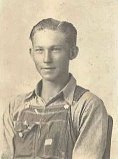
William Ruis Stovall

William Ruis Stovall

On August 12, 2013 my father William Ruis Stovall would have reached his 100th birthday.  Ruis was born in Morgan County, Alabama, where he resided most of his life, less the years during the depression when he worked farming in Tennessee, dock work on the  New Orleans waterfront, and wheat harvesting from Texas to Canada.

Ruis joined the US Army in 1937 and was stationed in Aniston, Alabama where he met Edith Virginia Matheney.  They were secretly married on March 13, 1937 and, upon his discharge, they moved back to North Alabama where they lived, more or less, for the remainder of their life.  Ruis eventually found stability with employment working for the City of Decatur, Alabama Electric Department, where he retired in the late 1970’s.

The union of Ruis and Virginia Stovall produced five children, Carolyn Dyann, Stephen Ruis, Peggy Ruth, William Robert, and Virginia Kay.

The lineage of William Ruis Stovall is:

Bartholomew Stovall
John Stovall
Drew Stovall
Drew Stovall Jr.
Philip Orr Stovall
William Absolam Stovall
William Claud Stovall
William Ruis Stovall

Posted in Uncategorized | 1 Comment