Original Farm of Bartholomew To Be Sold

FrancisEmma and Bartholomew Stovall’s Farm To Be Sold

In an article released Thursday, May 5, 2016 by the Richmond Times-Dispatch stated that the leadership team of the Sisters of the Blessed Sacrament announced the unexpected sale of the 2,200 plus-acre property in Powhatan County.

FrancisEmma

FrancisEmma

POWHATAN – Local supporters of FrancisEmma are still reeling after a surprise revelation from the leadership team of the Sisters of the Blessed Sacrament announced the unexpected sale of the 2,200 plus-acre property in Powhatan County.

The sale, which was announced on Tuesday, May 3, came as a complete shock to the five nuns who live and work on the property and the FrancisEmma Inc. board of directors, which manages it, said Sister Maureen Carroll, executive director of FrancisEmma Inc.

Carroll said the sisters who live with her at Belmead on the James and the board found out a few days before the announcement went public, but they are still in shock and disbelief.

“The sisters here at Belmead are extremely distressed by the announcement that went out,” she said.

Local reactions

The nuns’ feelings were echoed by community members in Powhatan County and elsewhere who have been working to both preserve and strengthen FrancisEmma for years.

There are generations of people with strong personal ties to FrancisEmma’s history as the location of St. Francis de Sales, a school for young black women, and St. Emma, an industrial and agricultural institute and a military academy for young black men. Before they closed in the early 1970s, these schools educated close to 15,000 students.

In more recent years, people have become entranced with the property’s beautiful setting and ongoing conservation work to protect the land and the wildlife it supports.

“FrancisEmma is a place of beauty, of history and of peace and it is a very important part of local history,” Carroll said.

Jennie Shuklis, chairman of FrancisEmma Inc., was at the board of directors meeting on Saturday, April 30, when the news was first announced and said it felt like she had the wind knocked out of her.

“There is shock, sadness, anger, grief. There is tremendous grief. Different board members have different feelings. Those are my personal feelings I have been working through,” she said.

Patricia Gunn, a former board member, wasn’t at the meeting but found out by email. For Gunn, the news was extremely personal. She is an alumna of St. Francis de Sales, just like her mother before her, her sister, and several cousins.

Only two months earlier, Gunn, who is chair of the FrancisEmma unto the Seventh General Capital Campaign, had spoken proudly of her time at the school at the dedication on March 5 of a new museum at Belmead Mansion that celebrates the property’s rich history. She also spoke of a bright future thanks to the many supporters who had rallied behind FrancisEmma in recent years.

So to learn about the sale of the property so abruptly was devastating, she said.

“I was deeply saddened and sorely disappointed that the work that has been so fruitful in the past 10 years was suddenly brought to a halt with no prior notice to the board, any of the Powhatan community, or any of the people in the state of Virginia who have been working so hard to preserve this history, this legacy and the land with so many species,” she said.

Carson Tucker, who represents District 5 on the Powhatan County Board of Supervisors, said he and others are dismayed by the surprise decision of the executive team of the Sisters of the Blessed Sacrament (SBS) in Bensalem, Pennsylvania to liquidate the FrancisEmma property.

The St. Francis de Sales and St. Emma schools established by Saint Katharine Drexel to give young black boys and girls access to a quality education have been part of the fabric of life in Powhatan County for more than a century, he said.

“They have represented SBS’s, Saint Katharine Drexel’s, and indeed the church’s highest commitment to humanity, equality, the environment and education,” Tucker said.

He went on to call the sisters who live at Belmead “nothing short of heroic in their management, maintenance, congruencies with SBS’s mission, and the search for adaptive repurposing of Belmead.”

Options for the future

Tucker said he wished the decision to liquidate the property had been done more transparently and collaboratively with alumni groups, historical and environmental groups, FrancisEmma’s neighbors and the community of Powhatan.

“Even now we as a community stand ready to engage in the discussion of how best to save Belmead and adaptively return it to the service of the people of Powhatan, Virginia and the nation,” he said.

Right now many people involved are working hard to assess all of the options they may have, Shuklis said.

“There are a lot of different plans on the table, and I am quite frankly not comfortable talking about all of them just yet until we have had a chance to look at them more thoroughly. But yes, of course, raising funds to buy the property could possibly be an option,” she said.

Hopefully, organizers will soon begin making appeals almost immediately to people in Virginia, members of the alumni groups and to people elsewhere who see the extraordinary value of what has been accomplished there over the last 100 years and more particularly during the last 10 years, Gunn said.

There could be a way to put together a consortium of people who value the extraordinary history and legacy of the property, which went from holding a plantation with slaves to later housing two schools for black boys and girls and now has been building a reputation for its conservation efforts, she said.

FrancisEmma’s environmental preservation work is essential to preserve the endangered species and rare species found there for future generations, Shuklis said.

It is also critical to continue to tell the story about the schools and the education of black students that took place there, particularly in these often racially charged times, she said.

“We need to make sure people know this is a resurgence of racism. Unfortunately it is not new and here are some of the beautiful efforts that went into combating it 100 years ago and here is what we can still work on today,” Shuklis said.

Gunn said she doesn’t believe some of the members of the leadership team of the Sisters of the Blessed Sacrament have a full appreciation for the extraordinary contribution that their religious order’s efforts have made across the past 100 years and the fruits they continues to yield even to this day.

“It is a gift that they gave 100 years ago that keeps on giving, and I don’t think they have any conception of it. Nor do I think they have any conception of the untold hurt and damage that might be done as a result of their selling the property,” she said.

While people involved in FrancisEmma fully appreciates the enormous responsibilities that the leadership team have, particularly to the order’s older nuns, Gunn said she thinks the decision to sell the FrancisEmma property, when it is engaged in so many ministries, is a mistake.

“For people who rarely come for more than just a four hour board meeting to make a unilateral decision that we are not viable and that the ministries there aren’t viable, it actually flies in the face of logic and is extraordinary hurtful to all of the hundreds of people who have been involved in this whole sacred venture,” Gunn said.

She added she hopes the leadership team will “prayerfully reconsider all of the extraordinary good that they are doing.”

Shuklis and Carroll said they would also appreciate the community’s prayers and support as they move forward.

For more information, contact FrancisEmmaBelmead@gmail.com.

Laura McFarland may be reached at Lmcfarland@powhatantoday.com.

Included is the text from the Richmond Times-Dispatch.

For more information, contact FrancisEmmaBelmead@gmail.com.If you would like to view the text from the Richmond Times-Dispatch visit:


 

Posted in Uncategorized | Leave a comment

Bo voyage – Literally

Friends of Bartholomew.

Thanks immensely for your recent support with interest in our book, Bartholomew Stovall – The English Immigrant.

I do believe I have fulfilled all book orders received and will now be on my way to Munich, Germany for a two week stay with my son Richard and his friend Ola Zinkiewikz.

Richard and Ola

Richard and Ola

Rachel, Herchel, and Mary, I did not receive your contact information before departure but will expedite this when I return, APR09. Barbara, I did get your book in the mail, but did not receive orders for your sister and friend.

My wife and I look forward to this journey via Atlanta – Chicago – Istanbul – Munich and then a duplicate return.

Peace Be With You All!
Bill Stovall


Posted in Uncategorized | Leave a comment

Grave Seekers

 Grave Seekers

Finding and Documenting History

In addition being the administrator of this web page, I am the Editor for the National Stovall Family Association newsletter.  I published this article, “Grave Seekers” in one of our recent issues.  It’s the tale that dates back two hundred years, when my distant grandfather and his family was settling the area around North Alabama.

The clan of Drury Stovall migrated west to Alabama sometimes around 1813.  Unfortunately, Grandpaw Drury only got a glimpse of his family prospering until he left his earthen vessel:  on May 12, 1826.  When I discovered that he was buried at Wise Cemetery, near Decatur, I set about the task of finding his burial place.

 Wise Cemetery Decatur, Alabama

Wise Cemetery
Decatur, Alabama

As written in the journal article, I did lay witness to Drury’s grave site. But what I DIDN’T write on was my follow-up quest: that being to assure that the State of Alabama recognizes this family cemetery as a historic place.  My first instinct was to contact a bureau at the State capitol and request the correct forms.

The people I worked with in Montgomery were extremely helpful, and within two weeks I held the dreaded package in my hands.

The story goes on and on, but I will summarize:

For those of you who are doing historical or genealogical research, or are in need of services such as my request, first seek help from the nearest County Archives Department.  These people are the subject experts, and their services are absolutely free.

In my case, I’m to spend approximately one hour with the Morgan County Archivist and then they will prepare the forms and file the request.

Hey, you never know until you ask!  –  Enjoy the article. . . I hope. . .

Stovall Family Association Seal

Stovall Family Association Seal

Grave Seekers

The Search For Drury Stovall Sr.

Members of the Stovall Nation are constantly searching for historical evidence of relatives dated back as far as possible. Hard core seekers pursue troves of old family Bibles and correspondence, courthouse records, libraries and the internet that might yield the secrets to their lineage.

We are a fortunate ancestry that can pinpoint the object of our exploration. Bartholomew Stovall was our Colonial roots founder, and we, as members of that descent, strive to obtain information as close to his generations as possible.

My bloodline travels through Bartholomew’s son, John, who left Virginia and headed west to settle land in North Carolina. One generation later his son, Drury Stovall, settled in North Alabama in the early 1800s.

Evidence indicates that other Stovall’s traveled with Drury and his growing family.  They were some of the initial founders of this lush farmland near the Tennessee River.  He and his wife Ann Stone Stovall raised a large family who helped develop this region and populated it with grandchildren that would help grow the city of Decatur into a commercial hub.

Drury Stovall Sr. was laid to rest on the twelfth of May, 1826. It was the same area where I was born and raised during the mid to latter point of the twentieth century. The “Stovall” surname has resonated throughout Morgan County for centuries. The lineage strain from Bartholomew remains strong in my section of the country, but today, our telephone’s white pages are running thin when you query our family name.

Reaching For My Past

Because of my kinship with this area, I felt a need to discover my ancestor’s place of burial. The location of their graves was predetermined from Stovall archives, and the position of their plots was pinpointed by satellite navigation systems from the World Wide Web.

In a compiliation by Donald E. Bishop, Descendents of Bartholomew Stovall (1665 – 1722) (First Five American Generations), Drury Stovall was buried in Wise Cemetery, Decatur, Morgan County, Alabama.  

The following is a brief story for the search and discovery of my distant grandfather’s grave site.

Tuesday, August 4, 2015

“Hello Brother.  I need your help.” 

Being somewhat internet savvy, I did a Google search of “Wise Cemetery, Decatur, Morgan County, Alabama”  and was rewarded with the following result set:

“Cemetery Notes and Description: From the intersection of Hwy 67 and Hwy 31 (Beltline Rd,), go west on Beltline Rd. on Central Pkwy.  Turn left and go 1.6 miles to 3704 Central Pkwy.  the cemetery is behind a residence and is very grown and snaky.”

As fate would have it, my brother, Stephen Stovall owns and works in an office building not three miles from 3704 Central Pkwy.  Steve is about as inquisitive as me, so I gave him a call.  The conversation went something like this:

Me: Well I just read that one of the founders of the area around Decatur, and our ancient grand paw is buried there. It’s located right down from your office at 3704 Central Parkway.

Steve: No Kidding! I know I can find that.

Me: Great! It says here that it “may be grown up and kind of snaky”. Just check it out and I’ll come over for an invasion when you validate it.

Wednesday, August 5, 2015

The next day I received an email from Steve: “I found the address and it is in a scary looking place.  I did not turn into the driveway because I was alone in my car.  The name on the mail box was Willie Garth and he has a phone listed at a different location.  I talked to a lady named Nellie Garth Jones and she now lives in the house and said Willie was dead.  She knows nothing of a cemetery behind the house but said we were welcome to look for ourselves.  I told her we would call before we came.”

I immediately replied: “I love an adventure. I’ll be in touch as soon as I get things figured out on my end.”

Early Morgan County Settlers

The land currently known as Morgan County, Alabama was claimed by both Cherokee and Chickasaw tribes of Native Americans prior to 1810. White settlers were quick to adopt this fertile basin and by 1818 a territorial census numbered 2,513 souls. This was considered a rather large concentration of people with farms, mills, taverns, and small businesses already in operation.

Shortly before 1818 the newly formed United States of America issued offerings of 640 acre sections for $1.00 per acre. Disgruntled settlers deemed the price too high and bartered with the government for cheaper, more flexible financing. All the while, families began to dot the area as “squatters”.

Seeing the handwriting on the wall, Cherokee tribes accepted a treaty with the United States. By 1816 the Chickasaw nation followed suit.

Before the first public land sale in Morgan County, the laws for disbursement made it possible for individuals to purchase smaller tracts. It’s historically written that on the first Monday in March, 1818 the first public land sale took place. After reviewing land and deed records I am convinced that this date was the first Monday in July, 1818. I found no sale of land prior to July, but numerous transactions are listed on July 18, 1818. Among them was a transaction to Peter Stovall, son of Drury Stovall for 60 acres in section 9, the land which is near the present day City of Decatur.

Alabama's Tennessee Valley From Mentone, Alabama

Alabama’s Tennessee Valley
From Mentone, Alabama

The roads between Atlanta and Decatur, Alabama could be 210 miles of interstate, but my wife and I chose to take the back roads, through the mountains.

Atlanta rests on the eastern edge of the Appalachian Mountains and Decatur is just west in the fertile Tennessee valley. The rise is only about 500 feet in elevation, but the summit displays the quaint, tourist town of Mentone, Alabama.

Leaving Mentone you quickly drop 1,200 feet into the Tennessee Valley with its lush farmland that is flat as the coastal plains. We crossed over the mighty Tennessee River twice before we reached Decatur, the area that Drury helped settle 200 years ago.

Wednesday September 22, 2015 – Wise Cemetery

Initially my Brother and I had planned to find the graveyard and uncover the whereabouts of Drury Stovall. Luckily, the search party swelled to seven people including a very inquisitive ten year old nephew.

 Wise Cemetery View From The Road

Wise Cemetery
View From The Road

We pulled into the driveway of Nellie Garth Jones and were greeted by a lady who advised us that the place of burial we were looking for was not located behind her home. She pointed to her right and said, “It’s in the back of that vacant lot, right next to that building.” This is when I knew I had found the destination of our search.   The area was identical to the shots I had seen on the internet weeks before.

We crossed the field and immediately saw grave markers and two burial sites that had four concrete slabs, upright approximately four feet high. My initial thought was that they were crypts, but as we looked closer, found that the underneath was secured with a thick concrete slab.

 Markers Everywhere Most Broken into Pieces

Markers Everywhere Most Broken into Pieces

The entire scene was in disarray with markers scattered around broken to pieces. Most all headstones had markings but time had worn the hand carved letterings so that none were legible, less a few.

I was excited that some of the etchings could be deciphered, but was delighted when I located the clearly marked headstone of Peter Stovall, obviously the burial place of Drury’s son who obtained a rank of Major in the war of 1812.

We looked inside one of the “caved in” crypts and were astonished to find one large stone with a faint markings of “STOVALL”. My adrenalin must have been flowing, because I lifted the 80 lb. slab out of the crypt and placed it flat on the ground to get a better visual. With a little cleaning around the lettering it became obvious that we needed to remove some of the residue before the etchings could be read.

Drury - No Doubt

Drury – No Doubt


Then someone said, “Bill, you should take a look at this.” Laying facedown outside the crypt, another piece of the headstone clearly showed the letters “DRURY” in excellent shape. We placed it next to the larger marking, forming a perfect fit with the name spelled out, “Drury Stovall”. There were viable dates, but one was fairly clear. 1826 shown through clearly, marking the date of Drury’s recorded year of departure from life on earth.

By the time we left for the day most of the headstone was assembled and placed on  plywood atop Drury’s crypt. Only one vital piece is left hidden in the brush. It’s a single triangular section that contained part of the headstone inscription. I’m sure it’s there and I will find it on a future trip.

It was a totally successful and very fun outing. For now I’m satisfied that the area has been located, but continuing forward I want to get back and clean the area up and make an attempt to have the graveyard recognized as a historical site by the State of Alabama.   Stay tuned for updates.

Finished Less one Piece

Finished Less one Piece


Posted in Uncategorized | 4 Comments

Runaway – Thomas Hardy

W A N T E D

Thomas Hardy—Runaway

Dunlap’s Maryland Gazette; or, the Baltimore General Advertiser

October 17, 1775 – July 28th, 1775.

FIVE POUNDS REWARD

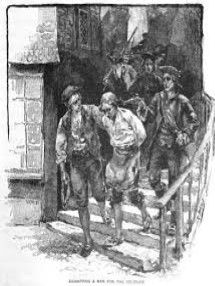
 R A N A W A Y last night from the subscriber living near the Northampton, Iron Work, Baltimore County, Maryland. A convict servant maThomas Hardyn, an Englishman, named Thomas Hardy. About five feet eight or nine inches high, grey eyes, short grey hair, about fifty-two years old, limps in his walk; he has a small hole in one of his lips, lost most of his teeth, talks in the North Country dialect; Had on and took with him, a white country cloth jacket, country row linen trowsers, good English shoes, two oznabrig shirts, old felt hat; he may have other cloths. Whoever takes up the said servant and secures him so as his Master gets him again, shall have 20 Shillings if 10 miles from home, 30 Shillings if 20 miles, 40 Shillings if 30 miles, 3 Pounds if 50 miles and above reward if one hundred from home, and reasonable charges if brought home, paid by:           John Robert Holliday.

* Replicated from Voyagers to the West (A Passage In The Peopling of America On The Eve of the   Revolution—Bernard Bailyn)


Posted in Uncategorized | Leave a comment

SFA Reunion 2017

SFA Reunion 2017

Charleston

Charleston, SC

YAY

Posted in Uncategorized | Leave a comment

Indentured Servants – The Fairness of the System

Indentured Servants

The Fairness of the System

Bartholomew Stovall, was born 1665 and immigrated to Jamestown, Virginia colonies in 1684.  If you have studied this emigrant then you realizes there are gaps in recorded history when you analyze the chronology of his relatively short life. Two of the most significant lapses are the span between the ages of ten and eighteen years. The other lapse is the span from 1684 and 1688 when he was bound by indenture to Dr. Richard Kennon.

Certainly everyone would like to know what happened to Bartholomew after his mother passed away in 1676. Any recorded history between 1676 and 1684 would help to explain who cared for the young boy and what may have encouraged him to barter himself into servitude and sail to America.

Personally, I’ve always been more interested in the period that he served his contract to Kennon. There is nothing recorded that tells of his character and habits during servitude. There is nothing to suggest that he was a runaway or that he was charged with indiscretions that would have extended his contract. I feel certain that he was a model servant, but the documents don’t exist to proves my theory.Oct9bookcover

Before I penned our novel, “Bartholomew Stovall – The English Immigrant” I did a great deal of study on Indentures. Invariably I got side-tracked and begin a study on the fairness of this system and analyzed the cause and effect of punishments.

To my amazement there are volumes written on this subject and some of it goes into such detail that I may regret attempting to bore readers. I did, however, document some of my findings and consider it relevant for an article in our Blog. This information is several years old and only skims the surface of a very complex issue. If you choose to read on, let me issue a word of caution. This stuff is not for everyone.

Historians vs Economists

Indentured Servitude was abolished near 200 years ago, but historians and economists are still divided on the fairness of the system. Historians claim that indentures were nothing more than slaves that were treated unfairly in that their masters could use the legal system to keep them as possessions for years beyond their contract termination.

Oct9boatpeople


                                                                           Colonial Gathering

                                      The Society That Wanted No Problems

Economist, on the other hand claim that the length of servitude was equal to the cost of the voyage to America, maintenance cost of the servant, and freedom dues given at the expiration of the contract. These same economist go so far as to claim that those who entered servitude usually did better than those who migrated to America and immediately bought land, because a period of servitude allowed them to learn the customs, culture, and language of America.

I doubt that this claim is spot-on if the servant was locating to the New England Colonies. But if their destination was the Central Colonies, this claim holds some validity.

“The System” It Worked—Kind of

If you remove the alleged bad points of Indentured Servitude, everyone agrees that the system worked to perfection. The Virginia Company of London, England crafted the model shortly after John Smith landed in Jamestown in 1607, but the Virginia Company went out of business in 1624.   Their demise did not distract others from maintaining the system as it was still being used more than 200 years later.

It was resoundingly successful attracting labor to America and was created on the premise that the price paid for the servant equals the value of the servant’s contract length. According to economist, it was the perfect system, but historians tended to believe that the system was exploitive when conflicts arose between masters and servants.

The research I did concentrated on two uniquely different issues when a face-off occurred between master and servant. Analysis was done from the side of both historians and economists. The results were predictable, but the conclusion was rather surprising. Read on for the discussion of these issue:

Pregnency

To say that a system was exploitive, we need to do a thorough examination of the crime vOct9womaninchainss punishment. First, let’s take the example of a female servant that became pregnant. The powers to be knew this was a probability and had enacted rules to counter the female indenture’s disobedience. But as time wore on, those rules were reworked until it was near impossible to calculate a master’s fair compensation for lost labor and expenses.

The rules and technicalities involved in dealing with “insubordination” are endless. If readers wish they can view http://www.ushistory.org/us/5b.asp. For the sake of this article I’ll paraphrase some of its content.

The colony of Maryland spelled out specific punishments for servants becoming pregnant during their terms of service. As early as 1684, an act concerning those servants that have bastard children provided that a servant unable to prove paternity would be held responsible for costs imposed on her master. If paternity could be established and the father was also a servant, he was held responsible for one-half the costs. If a freeman were the father, he was responsible for the entire cost. A 1692 law subsequently established severe penalties for white servants having mulatto children, reflecting social inhibitions concerning mixed-race relationships.

If a servant were to become pregnant, the court considered lost earnings and medical costs when assigning her extra service. Again, using data regarding slaves, a pregnant slave was usually given light work, or 50-60% of normal activity, once it was known that she was pregnant.

This half-time work load usually began in the third month and lasted until the eighth month. During the last month of pregnancy the slaves work was reduced to nearly nil. For the next year it can also be assumed that the woman would continue to work only at 50% of her usual work load because she had to breast feed and nurture the baby.

Women slaves were unable to perform labor for about four weeks following childbirth, followed by another year of light work because they had to breast feed about four times per day. The total amount of earnings from the pregnant woman is then subtracted from normal earnings of a woman servant, thus showing earnings lost due to pregnancy. The total cost of the pregnancy, then, would include lost earnings and medical costs. Taking all of this into consideration, the court would order her to serve an additional 280 days to 320 days when calculating the lost productivity.

Oct9womanbeatingIn addition to extra time, pregnant servants were sometimes punished by whippings. On average, the servant received 12 lashes in addition to her extra service, but the number of lashes ordered by the court ranged from zero to 30. In the case where 30 lashes were ordered, the servant was a third offender.

It is important to note that between 1755 and 1778 corporal punishment was phased out.   The courts may have modified their views to reflect changing times, or differing social morals. As real wages rose in Britain, better contract terms were needed in order to attract servants to America. Perhaps as a result, corporal punishment was phased out. Although this was not reflected in legislation or in the terms of indentures, the customs of the land may have adapted to changing economic conditions and social values.

The information I reviewed went so far as to draw a parallel between a single lash to a servant to the lost days of service, and then computed that value to a monetary unit and then into the amount of tobacco it yielded. I will not go into that much detail in this article.

I’m attempting to emphases that the courts went so far as to micromanage the effects of a single lash administered using corporal punishment. It was a cruel form of reprimand but it’s fair to note that some thought was put into lashing instead of it being treated as a simple retribution for insubordination. The instances of this punishment have been studied and it was concluded that punishment by public whipping appears quite harsh.

The significance of this is that whippings were extreme punishments used both to embarrass the servant as well as to deter other female servants from becoming pregnant during their term of servitude.

Runaways

 A Pennsylvania law passed prior to 1682 concerning runaway servants stated that, “Servants shall be Adjudged by the Court to double the time of such their absence by future Service over and above other Damage and Cost and that anyone aiding the runaway shall forfeit twenty pounds to the Master…and be fined five pounds to the Court…Also, anyone harboring or concealing a runaway shall forfeit ten shillings for every Days entertainment or Concealment.Oct9Runaway

In 1683, Pennsylvania enacted a new law providing for a penalty of five days for every day absent, after the expiration of servitude. Further, the servant must compensate for the damages, costs, and charges, to be determined by the County Courts.

Laws in early Maryland prescribed punishments considerably more severe than those in Pennsylvania. In 1638, for example, several lashes

were the punishment for running away. In the following year, the punishment was extended to hanging the runaway. By 1641 the law was changed such that death would be the punishment unless the servant requested that their service be extended after the expiration of the contract. The service could be extended up to twice the time absent, not to exceed seven years.

In 1650, time was doubled and the servant was responsible for damages and costs incurred by the master during the servant’s absence. In 1666 the law was again altered providing that a servant would serve 10 days extra for every one day of absence.

Convicts

Transported convicts, both men and women, were sold to plantation owners as another form of labOct9Convictor. One-fourth of the British immigrants to the colonies were convicts. Most of these convicts were male, young, unskilled and poor. The usual crime was grand larceny. Generally the only people exiled were those that judges felt could be rehabilitated. Convicts performed the same type of work as indentured servants but were less trusted. Their length of service was usually longer than that of the indentured servants. Like indentured servants and slaves, convicts frequently ran away. Political prisoners also were shipped to the colonies. Most of these were convicted following religious persecutions.

Conclusion

The results of the study I examined support the Economic Historian in their belief that the 16th- and 17th-century system of Indentured Servitude was efficient and effective in increasing the labor supply in America.

Examination of the individual court cases involving servant crimes also shows that indentured servants were not exploited or mistreated once they arrived.

Admittedly there was some mistreatment , but when considering the system in its entirety, the good outweighs the bad. The evidence, however slight, does not suggest that the indenture system was biased toward masters. Contrary to what we have been led to believe, servants were not abused in large numbers.

Oct9Peacfull

               More often than not, a system that worked for the good of all.


Posted in Uncategorized | 1 Comment

The Case for Henry Randall

Indentured Servants

Freedom and Fairness or the Folly of Misfortune

 When I penned our novel, “Bartholomew Stovall – The English Immigrant”, a majority of my research concentrated on Indentured Servants and the way of life in early Colonial America.  Less is written about the pre-revolutionary war America than those times when our nation’s founding fathers created documents of freedom that encouraged our citizens to take up arms and help build a nation united in a common cause.

One mindset is of the opinion that America obtained its greatness due to a select few whoBetsy Ross had courage, intelligence, and foresight to motivate the masses and demand a call to arms.  Men like Washington, Jefferson, Henry, and Adams are but a few that united the sparsely populated colonies to fight for independence.  By the time the overmatched Americans had driven out a well trained and equipped British army, the world looked on in amazement at the fortitude of our young nation.

While those brilliant men did ‘show the way’ for a path to greatness, our success can also be attributed to another segment who fought a war every day, long before the conflict with the British.  Those were the men and women who created our first exports, built our infrastructure, and established the first families that were the foundation for a well-ordered society.

During the years between 1650 through 1750 our nation was developing an identity.   Sophisticated cities were growing and rootless travelers were converting paths into roadways.  Tributaries were being used as much as the rivers that fed them and pioneers were developing land west of the wilderness settlements.

Despite almost impossible odds, some indentured servants begin to prosper.  Hard work paved the way for attainment, but it there was a common perception that “luck” played a larger part parlaying opportunity into success.Hard Working Farmer

“Luck” can be interrupted in many forms, but more often than not, it was defined by the temperament of a servant’s master.  As an example, allow me paraphrase parts of a short story from The Way Our People Lived by W.E. Woodward.

 Henry Randall Luck or Hard Work?

 Henry Randall lived in London, England and sold vegetables from a cart.  He had no family to support and never carried more than two or three shillings at a single time.  He had heard people speak of Virginia as a new and rich land and decided to go there – but he had no money to pay his passage.  A ship’s captain agreed to take him if he agreed to become an indentured servant for seven years.  The fare cost ten pounds and the captain was to sell him to a master when the ship reached Virginia.

Henry had the good fortune to be sold to Thomas Whitaker, a planter who was kind and generous.  Years before his servitude had expired Randall was given a cow and a litter of pigs by his Master.    In course of time the cow had a calf and the pigs increased in number.  Randall sold cows’ milk to customers in Williamsburg.  When the pigs were grown he slaughtered them, smoked their hams and bacon in Virginia style, and sent this choice meat to England to his master’s agent to be sold for him.  With the shipment went more than thirty skins taken from beavers he had caught in Traps.

Henry wrote to the agent in London to take the money coming from the sale and buy with it a number of articles of luxury, such as silk handkerchiefs, perfume, finely carved pipes, mirrors and razors in their cases.  These goods came just after he had finished his seven years’ servitude.  He sold them to plantation owners and their ladies at three times their cost in London.  With this money he bought goods that Indians favored and took them to the frontier, where he traded them for skins.  The skins went to London, and a shipment of luxuries came back to Virginia.

Trade TriangleThis three-cornered trade continued for several years and Randall accumulated a considerable amount of money.  Then he went into the business of importing men and women.

Under Virginia law anyone who brought a settler, indentured servant, or a slave into the colony received a “headright” from the colonial government.  This head right entitled its owner to fifty acres of land on condition that it is occupied within two years.

Randall went to London and arranged with a shipping agent there to act as a procurer of emigrants.  When they reached Virginia he sold them to planters on indentures that ran from five to ten years.  When he died in 1700 he possessed three thousand acres of land, of which twelve hundred acres were under cultivation.   He was also the owner of a mercantile business and several ships that brought slaves from Africa.  Soon after his servitude to Whitaker had expired he married a maid servant who soon gave birth to a son, Henry Randall Jr.

When Henry Randall Sr. passed away his son was one of the most influential farmers in the Tidewater.  Randall Jr. was not at all ashamed of his father’s humble origin, but rather proud of his rise from poverty to wealth.

The rise of Randall Jr’s father from the indentured servant classhouse of burgeses to a position of wealth and authority was not unusual if you mix luck with hard work.  Contrary to popular belief the indentured servants were not all criminals, not even a majority of them were.  But all were poor.  Among the poor adventures there happened to be those who were clever, enterprising and able.  To a large degree they must be considered the founders of modern Virginia.  In 1665 half the members of the House of Burgesses had come to Virginia as indentured servants.


Posted in Uncategorized | Leave a comment

Journal Editor Celebrates 70th Birthday (kind of)

William Robert Stovall Sr., editor of the National Stovall Family Association Journal recently confessed that he has reached the 70th year of his life; a milestone he never thought possible.

Bill Giving Speach

William Robert Stovall Sr.

Mr. Stovall delayed a preliminary announcement, suggesting, “I really wasn’t certain of my born on year, and I forgot where I filed my birth certificate. My wife and I searched all through our records and had almost given up until she located it in my sock drawer.”

Stovall, who also penned the well-received novel “Bartholomew Stovall, The English Immigrant” has been published in numerous periodicals and concentrates primarily on human interested and historical features.
Bartholomew Stovall is a finely crafted chronology of William’s grandfather from nine generations past. It’s an enthralling tale of the English Immigrant who indentured himself at age eighteen and sailed from England to America in 1684.
In a recent conversation, Mr. Stovall spoke openly about aging and the realities of reaching seventy years.
Me: Bill, are you of the mindset that seventy is the new fifty?
Stovall: No, I don’t believe that at all. I don’t feel like I’m fifty, I feel like I’m seventy. When I was fifty I ran four miles every day for exercise. By the time I reached my mid-sixties I had screws in my ankles and a knee replacement. When I had to quit running, I had a few good years in the gym, but they won’t let me go there anymore.
Me: They won’t let you go to your gym anymore?
Stovall: Yeah, there were signs that said “Free Weights” so I started taking them home. That only lasted until they cancelled my membership. From that point, I have not had a steady workout routine. It bothered me for a while but I’ve come to realize that exercising everyday just means that you die healthy.
Me: Er . . Well, Bill . . . you look in good shape . . . for a man of seventy years. Surely you can attribute this to . . . some secret.
Stovall: Yeah, I don’t worry a lot. I’ve always lived by the philosophy that you should never worry about things that don’t worry about you.
Me: . . . So, let me get this straight. You have eliminated worry?
Stovall: I won’t say that I have eliminated worry. I just don’t dwell on things like most people who are younger. When I turned seventy I realized that, not only did I survive my sixties, but I also survived the sixties. I think that speaks well for anyone my age.
Me: ? ? ? Bill, can you reflect on your childhood and tell how things have changed in seventy years?
Stovall: Yes, when I was a child, I was very young.
Me: But . . . Bill, you’re only seventy. Surely there are things you can recall?
Stovall: Yes, I can remember when the Dead Sea was only very sick.
Me: Oh please Bill. Again, you are only seventy. It’s not like you are ancient.
Stovall: Let’s put it this way. If things improve with age, I’m approaching magnificent.
Me: Well, OK! . . . Mr. Stovall, are there any tips you might want to add before we conclude?
Stovall: Yes. At my age, I will say that I know my way around. I just don’t feel like going.

Posted in Uncategorized | Leave a comment

Anybody Know Of William B. Stovall’s Parents?


Stovall Family Association member Brenda Jones is searching for information regarding one of her ancestors. So far all genealogy searches have been unsuccessful locating the parents of William B. Stovall. Please read the information from Brenda posted below. If you have any information, post a response to this or contact bkjones49@msn.com.

In search of information on the parents of William B. Stovall born in 1824 supposedly in Alabama (could be GA).  He was married to Jane P. Enis, place unknown.  He died in Bradley County, AR in Apr 1870 according to the Mortality Schedule.  They had the following children:


  1. Thomas (could be John Thomas) b: 1845 in AL
  2. Melcena b: 1848 in AL
  3. Nancy b: 1850 in AL m: J Y Mann
  4. Iola or DeSoto depending on the census b: 1854 in MS
  5. Amanda Eliza (my gggrandmother) b: 1856 in MS m: James R. Mann in Pennington, Bradley Co., AR
  6. Eliza Jane (Jennie) b: 1857 in AR
  7. Joseph Andrew b: 1858 in AR m: Louisa Lavenia Nunley
  8. Margaret b: 1861 in AR


Please respond to bkjones49@msn.com.

Posted in Uncategorized | Leave a comment

The Lands Over There

This is from “The Outline of History / The Whole Story of Man” by H.G. Wells.  It will appear in the May 2015 issue of The Stovall Journal.  I’m sorry to all you Stovall’s who are a member of the Stovall Family Association and will receive the journal, but I found this to be so interesting that I couldn’t resist posting.

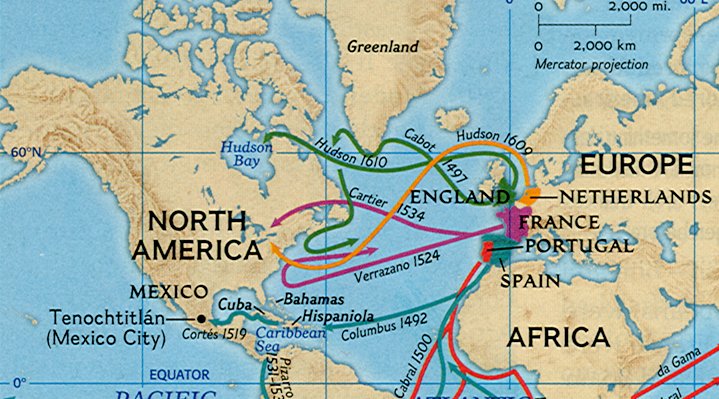
This is the mood of European leaders after they begin to comprehend the discovery and exploration of the lands across the Atlantic Ocean.

European Explloration Map

“The discovery of the huge continent of America, thinly inhabited, underdeveloped, and admirably adapted for European settlement and exploitation, the simultaneous discovery of great areas of unworked country south of the torrid equatorial regions of Africa that had hitherto limited European knowledge, and the gradual realization of vast island regions in the Eastern seas, as yet untouched by Western civilization, was a presentation of opportunity to mankind unprecedented in all history.  It was as if the people of Europe had come into some splendid legacy.  Their world had suddenly quadrupled.”


Posted in Uncategorized | Leave a comment