Sometimes before the sixteenth century a family of farmers and field hands left France, crossed the English Chanel, and settled in southern England in the area presently known as Surrey. History has recorded this group of people carried the surname of Stoffold, Stovold, or Stowell, depending on the generation. It is a misconception to think that they attempted to hide their identity by this frequent change. Most of the clan was illiterate and simply sounded out their name without ever recording it in a written form.
By the early Seventeenth century legal documents begin to appear identifying these people as ‘Stovall’. With the advancement of literacy, the name stuck and was adopted for use by the generations that followed.
Bartholomew Stovall was a member of the Stovall clan and is an example of those who endured and persevered during this time period. Although little is known of Bartholomew, certain facts of his life were documented which allow us to shape an image of his life and times.
Bartholomew did indeed have a grandfather who was a blacksmith and sired a son, George, who was born in 1623. George himself sired a son, Bartholomew, born in 1665. George, a converted Quaker, died the same year of his son’s birth when the great plague took the lives of an estimated 100,000 people in England. Bartholomew’s mother raised her only child until she died when he reached the age of 10 years, leaving him an orphan. Shortly before her death it is recorded that Joan Stovall brought her son before a Quaker Friends Meeting in 1675 asking for someone accept him as an apprentice.
It is also recorded that Bartholomew was baptized at St. Peter and St. Paul Church at Albury, Surrey on November 11, 1683, probably in order for him to be considered for immigration to the American Colonies as an indentured servant. Quakers were not afforded this opportunity.
Booth
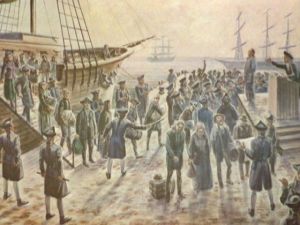
Bartholomew actually set sail on July 7th, 1684, bound for Jamestown, Virginia on a boat named the Booth, captained by Peter Pagan. He worked on a plantation owned by Richard Kennon of Henrico County Virginia and completed his four-year indenture obligation. He married Anne Burton in 1693 and was the father of six children. At the time of his death, in 1722, he owned a tobacco farm that yielded 318 acres at the point where Deep Creek flows into the James River in what is currently Powhatan County Virginia.
By the early part of the twenty first century there were hundreds of thousands of offspring from this lone orphan who left England as an eighteen-year-old young man of adventure. Records show that Bartholomew is the lone documented ‘Stovall’ to immigrate to America meaning that most all Stovalls living in the United States can trace their lineage to Bartholomew.
Those who follow Bartholomew Stovall are aware that a picture of his life can be drawn given the few critical dates that are recorded about this man’s life. Bartholomew’s birth date, August 24, 1665. is substantiated by Quaker records of Guilford that currently resides in the Library of the Religious Society of Friends, Friend’s House, Euston Road, London, England.
The orphan Bartholomew Stovall did sail from England in 1684 on a ship captained by Peter Pagan and made a life in the Virginia colonies. He served as an indentured servant for Richard and Elizabeth Kennon, and then became a farmer. He married Ann Burton and had six Children. The union of Bartholomew and Ann is the root of a lineage that today, numbers into the hundreds of thousands.
Happy Birthday Bartholomew and thank you for your decision to migrate west.
Note to all Stovall kin: On August 24th we will be observing the birthday of our ground zero American Grandfather, Bartholomew the Immigrant.
We are aware of this significant date because it was preserved in the Quaker records of Guilford and currently resides in the Library of the Religious Society of Friends, Friend’s House, Euston Road, London, England. On those manuscripts the entry reads:
Stouell Bartholomew, son of George and Jone, Allbery, 1665.6.24 Guildford
Wait! That entry lists the date 1665.6.24. Isn’t that June 24th, 1665, not August 24th, 1665. Rest assured, Bartholomew was born on the 24th of August. It appears as June because the prevalent religious practice in England during this period regarded March as the first month of the year, thus August is rolled back to the sixth month.
One may ask, “What prevalent religious practice would cause this offset in the monthly numbering system?” The answer to this pertinent question can be found in the book of Luke in God’s Holy Bible.
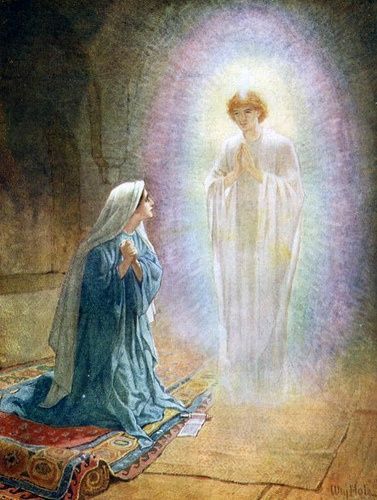
In an event named the Feast of Annunciation, Gabriel the Archangel was sent by God to visit Mary and advise her that she was to give birth to His Son and to name him Jesus. According to Biblical scholars this took place on March 25th. Perhaps because of the Annunciation’s significance, March is sometimes considered the first month not the third month of the year, therefore skewing the sixth month to appear as August, not June. Thus, explaining why the entry appeared as 1665.6.24, when in actuality, and widley accepted as fact, Bartholomew was born 24 August 1665.
Readers of our novel, Bartholomew Stovall – The English Immigrant, know that George Stovall, father to Bartholomew, was a victim of the 1665 pandemic that ravaged London. It is certain that all in America who carry the Stovall DNA were directly impacted by this singular casualty. A victim of his father’s untimely demise, Bartholomew grew up in poverty and found few prospects for a prosperous career in his native England. As a young man he decided to pit his chances on life in the new world of America.
Bartholomew’s quest fashioned an American lineage that represents the embodiment of our country’s heritage. From the Atlantic to the Pacific we are thankful for our freedom, but currently find ourselves dealing with a pandemic in our modern world. Covid-19 will most assuredly become the most documented pandemic in all of history, but could the panic and confusion it generated have been predicted if comparisons were made to the Black Plague that befell Europe during Bartholomew’s time?
In late fall of 1664, a large ship left the seaport in Amsterdam loaded with a cargo of cotton. She traversed into the North Sea and then steered southward, bound for the Port of London. The tightly bundled bales were an essential commodity for the mills and weavers who spun the cotton thread, and in turn produced the fabric used for apparel and bedding.
History records that the cargo of cotton was accompanied by colonies of flea infested rodents that made their way off the ships and settled into the streets and shanties of London. Unbeknownst to everyone, the fleas carried the bacterium bacillus or the contagion that produced the Bubonic Plague.
The Bubonic Plague ravaged Europe for most of three years and claimed more than 30,000 lives in Amsterdam. By the end of 1665 one third of London’s populace would perish, well over 100,000 souls.
Perhaps the number of casualties would not have been so great if officials had taken heed to early warning signs. Isolated cases of the plague were reported in the outskirts of London, but these instances were ignored when reoccurrences did not appear to materialize.
Blockade On Thames
Additional measures were made to avert the threat by placing a blockade at the mouth of the River Thymes and ordering all ships from infected areas to spend 30 days in quarantine before entering into the Port of London. The intent may have been prudent but proved ineffective in helping prevent the spread.
By May of 1665 London’s contamination reached such an alarming level the affluent Gentry Class commenced their exodus from the city. Large wagons could be seen transporting family and household staff, fleeing with what few goods and supplies they could gather. Even King Charles II abandoned his residence at Westminster and relocated to safety at Oxford. His departure left the appearances that London’s situation was desperate.
Plague Doctor
In June 1665 government officials made it clear that measures must be put in place to “flatten the curve” of the spreading contamination. Large gatherings were prohibited, and people were encouraged to refrain from mingling in the streets. Taverns and pubs were temporarily shut down, schools and universities were closed, sporting events were cancelled, travel restrictions were put into place, and finally, people were advised to stay indoors.
At the height of the spread, as many as 8,000 souls perished per day. With no one moving about and no goods being exchanged, the city’s economy collapsed. Horridly so, the casualties increased causing death carts to patrol the streets. London had turned into a graveyard.
The contagion held its grip until the Winter of 1665 when strong north westerly winds forced all creatures large and small indoors, away from the cold. When the outside temperature plummeted, so did the casualty count. Londoners greeted the good news with caution but remained optimistic that the spread may have run its course. First the cobblers, seamstresses, and local merchants opened their doors for business. Then bakeries, pubs, and places of worship joined other establishments attempting to bring their city back from the dead.
Months passed with no significant occurrences reported, prompting the people of London to breathe a sigh of relief that the worse of the plague was behind them. Then on September 2, 1666 their elation was shattered when a careless baker at Thomas Farriner’s bread shop on Pudding Lane neglected an overheating oven. Within three days’ time, the great fire of London destroyed over eighty percent of the homes and public buildings within the walls of the city.
Some say the fire finished off what remained of the dreaded illness that had claimed one third of the populace. Perhaps this is so, but as a result of the fire a new London was built replacing the narrow cobblestone pathways with carved streets and sewer drainage. Gone were the thatched roof dwellings, all being replaced by buildings made of stone, some containing two or three hearths. Gone was the dread of the plague, replaced by an attitude of optimism. London was reborn to become one of the worlds great cities.
The large cities of Europe were the epicenter of contamination, but eventually the Black Plague moved into the small towns of England. Not to be spared was the farming community of Albury, Guildford Borough, Surrey, home to George and Joan Stovall and their newborn son, Bartholomew. George Stovall was inflicted with the Bubonic Plague just a short time after the contagion dramatically decreased. He was the unfortunate victim of a pandemic that had crested and was falling. George succumbed to the plague on November 8, 1665, just weeks after the birth of his only child.
History did not record the widow, Joan Stovall’s years following the death of her husband. In all appearances she remained in Albury and provided for her son. It is documented that she attended a Quaker Friends meeting with her son in 1675. A short time later she passed away leaving ten-year-old Bartholomew an orphan.
By the time this young orphan reached the age of eighteen years, he was sailing to the American Colonies on a ship filled with other indentured servants. He would spend four year as a purchased plantation worker and would eventually spawn an American lineage that has survived since 1684.
“Which of Bartholomew’s children is your lineage?” It’s a frequently asked question at National Stovall Family reunions. I’ve seen instances where attendees wore a name tag listing George, Bartholomew, Hannah, Thomas, John or William to identify their parentage. Why is this important information? The obvious answer; when this critical piece of the genealogy puzzle is unraveled your ancestry is completed to Bartholomew the Immigrant, the original “American Stovall”.
When speaking on heritage or lineage, near everyone who carries the surname Stovall are a blessed lot. We are all armed with the knowledge that a straight line is drawn from our ground zero Grandfather, Bartholomew Stovall, directly to our family doorstep.
Equally important is the revelation that any Stovall descendent in your lineage line assures that you carry the DNA of the amazing young English immigrant who symbolizes the embodiment of America’s success.
For those who need help tracing your genealogy I suggest contacting the Stovall Family Association, (www.stovall.org, or Facebook at Stovall Family Association). One of their stated goals is to bring into contact all those persons who are researching the Stovall line and allied families. This organization is also in possession of the official Stovall Database, the most extensive and accurate collection of Stovall family tree data in existence.
Bartholomew Stovall was the only child of George and Joan Stovall, from Albury Surrey Parrish, England. He was fatherless as an infant and orphaned at ten years. It is documented that, at the age of eighteen, he was baptized into the Church of England, and soon after signed an indenture agreement obligating himself to four years of servitude in the America Colonies. He boarded the slave hauling ship, “Booth” on July 7, 1684, captained by Peter Pagan, and set sail for Jamestown, Virginia Colonies.
Bartholomew Stovall served Richard Kennon at his master’s tobacco plantation in Conjurer’s Neck, VA for four years. He completed his obligation in 1688 and eventually settled on a virgin 320-acre plot where Deep Creek empties into the James River in Powhatan County, VA. He married Ann Burton from Cobb’s plantation where the couple raised a family of five sons and one daughter.
Ironically, Bartholomew Stovall is the only documented surname of “Stovall” to immigrate, meaning that all Stovall’s in America can, most likely, trace their roots back to this lone immigrant. It is easy to suggest that by 2020 the Stovall clan could number into the millions.
Today there are numerous clubs, groups, or social media outlets that cater to the “Stovall” brand. The common theme among these organizations is twofold. #1. Discover and interact with new relatives. #2 Celebrate our ground zero Grandfather, Bartholomew Stovall, who made it possible for his lineage to live in freedom in America.
Early spring in rural Georgia is usually a peaceful presence, unless you are climbing embankments searching for old, unkept graveyards. On April 6, 2019 my sister and I engaged in this exploration searching for the stone with the markings of W.R. Stovall. His date and place of birth and death is unknown, but as you will see, there is ample evidence that Mr. Stovall was very much alive and prospering just as the twentieth century made entrance.
Of course Kay or I would have been thrilled to find evidence of any Stovall committal, but it would be a bonus to discover the resting place of the former town senior of Stovall, Georgia. He was the man for whom Stovall Road was named. The paved corridor meanders for ten miles through Troupe and Merriweather Counties. Near the midpoint of Stovall Rd, between Lower Big Springs Rd and Greenville, GA, lies the town of Stovall.
Along the roadway we spotted a billboard with directions to Stovall Baptist Church. We took a risk and were surprised to find the fair-sized place of worship. The building looked newer than I had envisioned, with updated siding painted pure white.
Obviously, this was an active church with manicured landscaping and a large sign displaying times of worship on Sunday mornings, Sunday evenings and Wednesdays. If Pastor Billy Allen were to draw a circle five miles around the church it is highly likely that most Baptist within the boundaries would attend worship at this location.
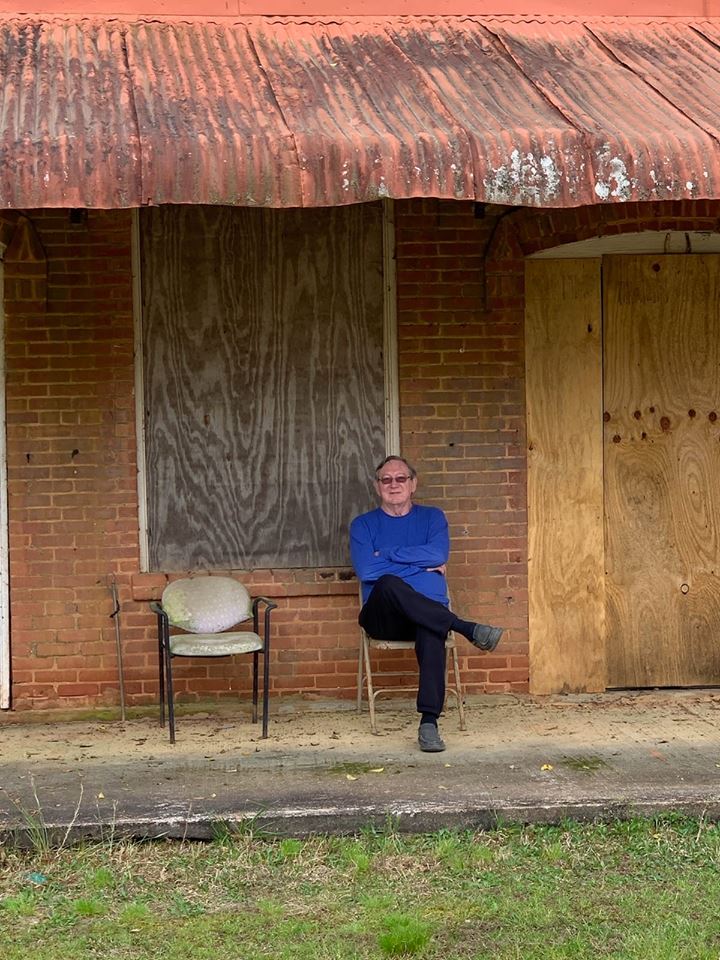
Looking on beyond the church the road dead-ends and changes from pavement to a lovely carved clay street. To our left and right we spotted two old brick buildings.
Kay drove slowly while we both pondered buildings that loomed to our left and right, all secured with boarding over the windows and doors. One structure looked like it could have been a store, but it stood two floors tall. I supposed that it could have been the only multi-use facility in all of Stovall, Georgia.
Straight ahead we could see the road drifted east, out of town. There was a spectacular white fence that lined the exit way for as far as my eye could see. The view was reminiscent of a small town Main Street.
To our right we saw a building that looked vaguely familiar. It was a large structure, longer than it was wide, that seemed to sit snuggly on a perch. Obviously, it was a non-operational facility, but my mind raced, Was this once a storage warehouse? Perhaps it was a distribution point?
I walked around to the back of the building and discovered what I assumed all along. There were dual train tracks, one was a main line and the other was a spur that once picked up grain or cotton from local farmers in and around Stovall, Georgia.
The old store looked structurally sound, but its windows and doors were boarded closed. I remember pondering if there was anything stored there or in the depot. My gut feeling being that both buildings were assuredly empty.
I did note that the long white fence terminated at the store. It was a defining spot where the rural meets urban. I also noted that the grounds were all mowed and manicured, just like the Church property. Could it be that the church maintained what was left of this isolated little town?
. . .
But as it turns out, Stovall, GA has several residents. Driving past a magnificent home near the old buildings, we were fortunate enough to spot a gentleman working in his yard. We stopped to inquire about the town and it happened that that this gracious man was the home owner and was willing to share his expansive knowledge of the town and it’s pastoral past. Kay and I introduced ourselves as ‘Stovalls’, prompting him to produce the original town plot that plainly states downtown Stovall, Ga was owned by W.R. Stovall. The framed document was dated 1906 and was presented as a land plot. It was an amazing artifact that showed downtown Stovall, and all the outlying areas.
a
Land plot for downtown Stovall, Georgia, in 1906.
“The Stovall’s owned pretty much all of this town. It was farming times, and their farm just ran out. There were a few seasons where the rain would stop just over there,” the man told us, pointing to the distance.
And then he pointed to the railroad
tracks, “There was a water tower just on the other side of the tracks. The steam engines came in and filled up with
water. But when the deisel trains come about,
the railroad quit stoping in Stovall. After
a few years the railroad tore down the water tower, claiming it was their
property, and they didn’t want to be held responsible for neglect.”
Kay noted the cemeteries on the large map, which brought the man to his full attention, “Get in your car and follow me,” he motioned to us. “I’ll show you two cemeteries and you can see for your self. As for me, I see too many ticks from the road to the headstones.”
The first cemetery contained some gravestones with birth dates in the late eighteenth century, but for the most part, the inscriptions were no longer legible. It was a small area with twenty or so graves that had been largely unattended.
Kay and I followed our guide to the second graveyard, but again he would have no part in scaling the embankment in search of the graves. He waited by the roadway while brother and sister reached the summit. Up ahead we could see many headstones grouped in a large, but neglected patch. When he saw that we had found our destination, he waved and departed in his pick-up truck.
I felt apprehensive as I watched the man drive away. There were so many answers I needed from him, but alas, he and his vehicle faded down the paved county road. Who is the caretaker of this historical little town that bears my family name? Are any of the farms still owned by families named on the land plot? What will the future hold for Stovall, GA? But most importantly; Where are the Stovall’s of Stovall, GA?
. . .
Kay and I searched the larger graveyard and found the stones were better preserved than the first cemetery we toured. We were able to decipher some headstones with the surnames, Hardy and Neal. There was little vandalism, just a few overturned headstones. Much like the first graveyard, it was overgrown with vegetation and appeared forgotten. To our dismay, there were no Stovall headstones.
. . .
Stovall, Georgia is representative of many towns or villages that sprang up shortly after the Revolutionary War. Soldiers wanted payment for their services and our new government had no money to pay them. Legislatures felt the need to proliferate the lands westward and offered free partials to those who were willing to claim the acreage. Within fifty years after America won her freedom from England, farming settlements were populating areas west of the Appalachian Mountains, particularly in the southern most part of our young country.
Stovall, Georgia is a bonanza for modern-day seekers who have an interest in these old settlements. Most are now ghost towns or unpopulated expanses of days gone by, much like the town of Stovall. Maybe some are fortunate enough to have a resident expert who can tell stories of the old town and prove his words with official land plots.
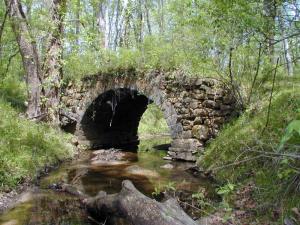
Other than Bartholomew Stovall’s vast lineage, he also left a fair-sized tobacco farm outside of Richmond, Virginia. He lived there no more than twenty years before passing, but ironically, the original 320-acre parcel can be identified today at a point where Deep Creek empties into the ocean bound River of James.
In the past, I’ve detailed the history of this sacred place. The farm has survived iterations of ownership; each century witnessing the plot being bundled with a larger parcel. Most of those who have read Bartholomew Stovall – The English Immigrant are not surprised that you can still walk on the grounds where Bartholomew harvested his crops and helped raise his family. Most of those who follow this blog understand how the terminus of a young English lads dreams could evolve into a sanctuary that focused on providing help for underprivileged African American and Native American men and women.
If you are not familiar with Belmead, I encourage you read this blog entry from 2013, before you continue with this post. It begins with an introduction of Bartholomew acquiring the first 320-acre plot and then continues with the progression of ownership.
In 1706, when Bartholomew Stovall walked the boundaries of his newly acquired 320-acre farm, he had no idea that the property would eventually be ravaged by giant construction machines.
One hundred and thirty years after Bartholomew’s passing, plantation owner PhilipSt George Cocke had no way of knowing that his magnificent, 1,200 acres, self-sustaining, plantation would be divided into parcels less than one acre, lined with carved, asphalt streets and stately homes.
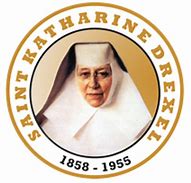
Fast forward to, 1890 and imagine Katherine Drexel considering plans to convert what remained of John Croke’s slave supported plantation into a home for African American and Native American girls and boys. How could she possibly imagine that the institution she had built using her own funds would be closed, abandoned, demolished and then sold to the highest bidder.
In May of 2016, the Catholic Church made their decision that the group of Nuns who looked after this sanctuary should retire or be relocated, and that all property and its assets would be made available to investors, implying that “Sister Katherine’s dreams have been accomplished.”
In February of 2017 the doors were bolted tight at Belmead and everyone was told to leave the premises. This holy sanctuary was officially closing it’s doors for good.
After two years, it appears that efforts have intensified, and other parties have shown interest in the 2,200 acre plot on the James. At this point, the worst-case scenario seems likely. Belmead may soon bear the name of the avenue leading into another overpriced suburban community.
Belmead on the James Inc.
With news that Belmead was for sale, a grass roots, nonprofit organization was formed with the goal of “acquiring the historic Belmead property and preserving intact as much of its 2,265 acres of land as possible.” Belmead on the James, Inc. (BOJI) stated that their mission is “for the benefit of present and future generations of Americans, as well as to preserve the cultural, historical, spiritual, ecological, and educational legacy associated with the property.”
So far, BOJI has raised $140,000 from organized donation campaigns. They have secured one million dollars in promissory grants from The Virginia Land Conservation Foundation, and the Virginia Outdoors Foundation.
They sent out a challenge to speculative investors who shared their ideas of preservation and conservation. With good fortune a philanthropic lender did step forward, but delays in the closure of Belmead forced the prospective lender to reconsider their commitment.
Today Belmead sits with no offers, but one very serious buyer who is trying to garner enough money for the purchase. Will the owner of this property wait until BMOJ has enough funding for closure, or will they sell to the first buyer and rid themselves of all the issues?
The property is over 2,200 acres of rich, river basin farmland. It’s filled with Loblolly pines and other hardwood trees, but parts of it are swampy and useless for development. Prospective buyers will note that there are cemeteries and many very large, old buildings on the grounds. Ironically, some of the structures are in good shape due to publicly funded efforts through donations. One thousand acres is protected by a Conservation easement, but none bear the seal of the ultra-protective, Historic easement.
Some of these items may appear as negatives for those looking to purchase the property. Ironically, BOTJ wants them to remain as is. Leave the graveyards to be managed by the caretakers. Leave the Church and the areas that have been restored for parishioners. The swamp laden marshes and the swift flow of the James; leave this all to nature.
In and around that area of Virginia, Belmead is a sensitive topic. It’s worth has been set and its history has been recorded. With the good Lord willing, our luck will continue and all three parcels can remain together, free in nature.
As of November 19 there are no significant details to report on the sale of Belmead. It is important to note that in closing it was mentioned, “for now we are not asking for additional donations for Belmead on the James.”
If you are interested in helping save Belmead look for an update on this blog page, or visit Historic Belmead on Facebook.
August 24, 1665, Bartholomew Stovall, my grandfather from nine generations past was born in Albury Surry, England. When Bartholomew reached the age of eighteen years, he boarded a the sea going ship, Booth and sailed to the new world of America.
Today, hundreds of thousands if not millions carry his DNA. Thank you George and Joan Stovall, parents of Bartholomew, for giving birth to our ground zero forefather here in the US. And Thank you Bartholomew for making that historic voyage.
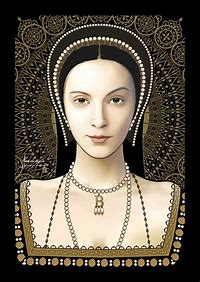
She captured the heart of Henry VIII and hastened Reformation
By the time young America created the Declaration of Independence, the mindset of their population had already formed core beliefs about how a government and the people should interact; government would operate by consent rather than decree. Then and today, few realize that this uniquely American marriage of freedom and justice shares a near link with the infamous Anne Boleyn, the second wife of Henry VIII.
In the novel, Bartholomew Stovall – The English Immigrant, Bartholomew knew his destiny. As a slave, he was forced to accustom his master’s rules.
By the time Bartholomew had earned his freedom in 1688, he understood that governing in the New World was much like that in his mother country, England. It was a government of representation and was imposed by a fair legal system, elected by the people. These facts helped Bartholomew to understand that, should he follow the path that was presented to him with nobility, the truth would be rendered, and he would find his destiny.
This provincial government Bartholomew found in America was a byproduct of the successful Protestant Reformation in England between 1500 and 1650. During a time of deep rooted religious oppression, noted authors were writing essays supporting the Enlightenment, and others were interpreting The Holy Bible from the Greek and Latin scrolls to English books, so “Even the plowman could read Gods word and form a personal relationship through prayer.”
But the turning point in England’s history had little to do with reformation. Britain and their provincial experiment, America, as well as large portions of the civilized world, should credit Anne Boleyn for their freedom to worship and to live in a true Godley spirit. It was Anne Boleyn, the former Queen’s maid and then second wife of King Henry VIII who used her charm, wit, and flirtatious manner to repel the forces of intolerance.
. . .
King Henry’s attraction to Anne Boleyn was not a quick romance. At first, she denied his advances, as well as the ‘formal request’ for her to become his solitary mistress. The king was taken aback by her refusal. Anne was steadfast against his charm, but the two did become close. Finally, she confessed her love for him, but reasoned that it would all be in vain because he was a married man.
With her refusal, the king became open with his intentions to marry Anne Boleyn, going so far as to summon the Pope and requested that his marriage to the Queen, Catherine of Aragon be annulled. But the Pope refused the request leaving Henry livid.
But liberation for the protestants took a huge leap forward in November 1528. On this date, King Henry VIII summoned Parliament and gave a masterful speech at Bridewell, London. The King confessed that he had been living in mortal sin, caused by his arranged marriage to his late brother’s wife, Catherine.
He quoted passage from the Holy Bible in Leviticus Chapter 20 Verse 16:
“If a man shall take his brother’s wife, it is an impurity; he hath uncovered his brother’s nakedness; they shall be childless.”
The King may have convinced the gathering when he stated that he lived in “detestable and abominable adultery”.
. . .
History has proved that King Henry VIII wanted to be rid of Catherine because she was barren and had not produced him a male heir. He was also infatuated with Anne Boleyn and wanted her as his queen and beds maid.
But history also proved that by bringing his request to Parliament, Henry was seeking support for his cause from the nobility of the country he ruled. He knew that he could not ‘decree’ to the Pope, thus he enrolled the help of the people to absolve the authority of domestic matters from a foreign entity.
Henry’s plea to Parliament was the turning point in England’s history. In incremental events, Henry VIII achieved his objective. On November 3, 1534 the Parliament of England passed the first Act of Supremacy, appointing Henry VIII as The Supreme Head of the Church of England. Finally, Henry was able to discern the legal sovereignty of the civil laws over the laws of the Church in England. This is to say that Henry could grant himself a divorce and then marry Anne Boleyn.
This sweeping turn of events altered England’s business model drastically. With Henry’s plea to Parliament England was now governed by consent rather than decree. It was a mindset that followed those who formed the laws and labored the fields of the New World.







 Obviously, this was an active church with manicured landscaping and a large sign displaying times of worship on Sunday mornings, Sunday evenings and Wednesdays. If Pastor Billy Allen were to draw a circle five miles around the church it is highly likely that most Baptist within the boundaries would attend worship at this location.
  right, all secured with boarding over the windows and doors. One structure looked like it could have been a store, but it stood two floors tall. I supposed that it could have been the only multi-use facility in all of Stovall, Georgia.
 To our right we saw a building that looked vaguely familiar. It was a large structure, longer than it was wide, that seemed to sit snuggly on a perch. Obviously, it was a non-operational facility, but my mind raced, Was this once a storage warehouse? Perhaps it was a distribution point?
 The old store looked structurally sound, but its windows and doors were boarded closed. I remember pondering if there was anything stored there or in the depot. My gut feeling being that both buildings were assuredly empty.



 In the past, I’ve detailed the history of this
  Fast forward to, 1890 and imagine Katherine Drexel considering plans to convert what remained of John Croke’s slave supported plantation into a home for African American and Native American girls and boys. How could she possibly imagine that the institution she had built using her own funds would be closed, abandoned, demolished and then sold to the highest bidder.
  With news that Belmead was for sale, a grass roots, nonprofit organization was formed with the goal of “acquiring the historic Belmead property and preserving intact as much of its 2,265 acres of
  The property is over 2,200 acres of rich, river basin farmland. It’s filled with Loblolly pines and other hardwood trees, but parts of it are swampy and useless for development. Prospective buyers will note that there are cemeteries and many very large, old buildings on the grounds. Ironically, some of the structures are in good shape due to publicly funded efforts through donations. One thousand acres is protected by a Conservation easement, but none bear the seal of the ultra-protective, Historic easement.
 She captured the heart of Henry VIII and hastened Reformation
 In the novel, Bartholomew Stovall – The English Immigrant, Bartholomew knew his destiny. As a slave, he was forced to accustom his master’s rules.
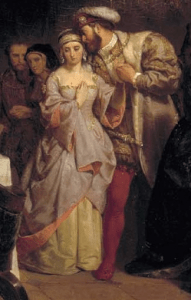 King Henry’s attraction to Anne Boleyn was not a quick romance. At first, she denied his advances, as well as the ‘formal request’ for her to become his solitary mistress. The king was taken aback by her refusal. Anne was steadfast against his charm, but the two did become close. Finally, she confessed her love for him, but reasoned that it would all be in vain because he was a married man.
 Bartholomew Stovall